BLACKSQUID / SYNATRAIL / COOKBOOKFIELD RECIPES · 03

↳ PUT THE POSSIBILITIES TO WORK

Three nodes.
A useful next move.

A question worth asking. Evidence worth connecting. A small enough idea to test.

Recipes for getting from an interesting canvas to a decision you can explain. Copy a prompt, change the inputs, and keep the reasoning that earns its place.

RECIPE 01 / WORKSHOP HANDOVER
  1. 01
    Where does the handover fail?Start with a question that changes a decision.
  2. 02
    What do the notes actually show?Separate supplied observations from assumptions.
  3. 03
    What is the smallest useful response?Define a handover log and a test for its value.
3 NODES → SCOPED ANSWER → LIGHT PACKAGE

What are you trying
to find out?

Each recipe gives you the ingredients, a way to connect them, an instruction for the agent and a stopping point. The three worked examples have real model runs behind them; the remaining recipes are patterns to adapt to your own evidence.

BEFORE YOU RUN

Create an investigation and connect a model in Model access. Review processing consent and limits there. Reading this cookbook and downloading its example use no model calls. Repeating the research or package generation uses your connected provider and the platform allowance shown in your workspace.

A better handover.
Before a bigger system.

A small workshop wants the next shift to know what is unfinished, who owns it and what happens next. Investigate whether a simple shared handover log is worth testing.

Decision: what should a first prototype contain, and what would make us abandon it? The cards below summarise the exact downloadable inputs, which are synthetic teaching material. A live model response can expose gaps in those inputs; it cannot establish that a real workshop has this problem.
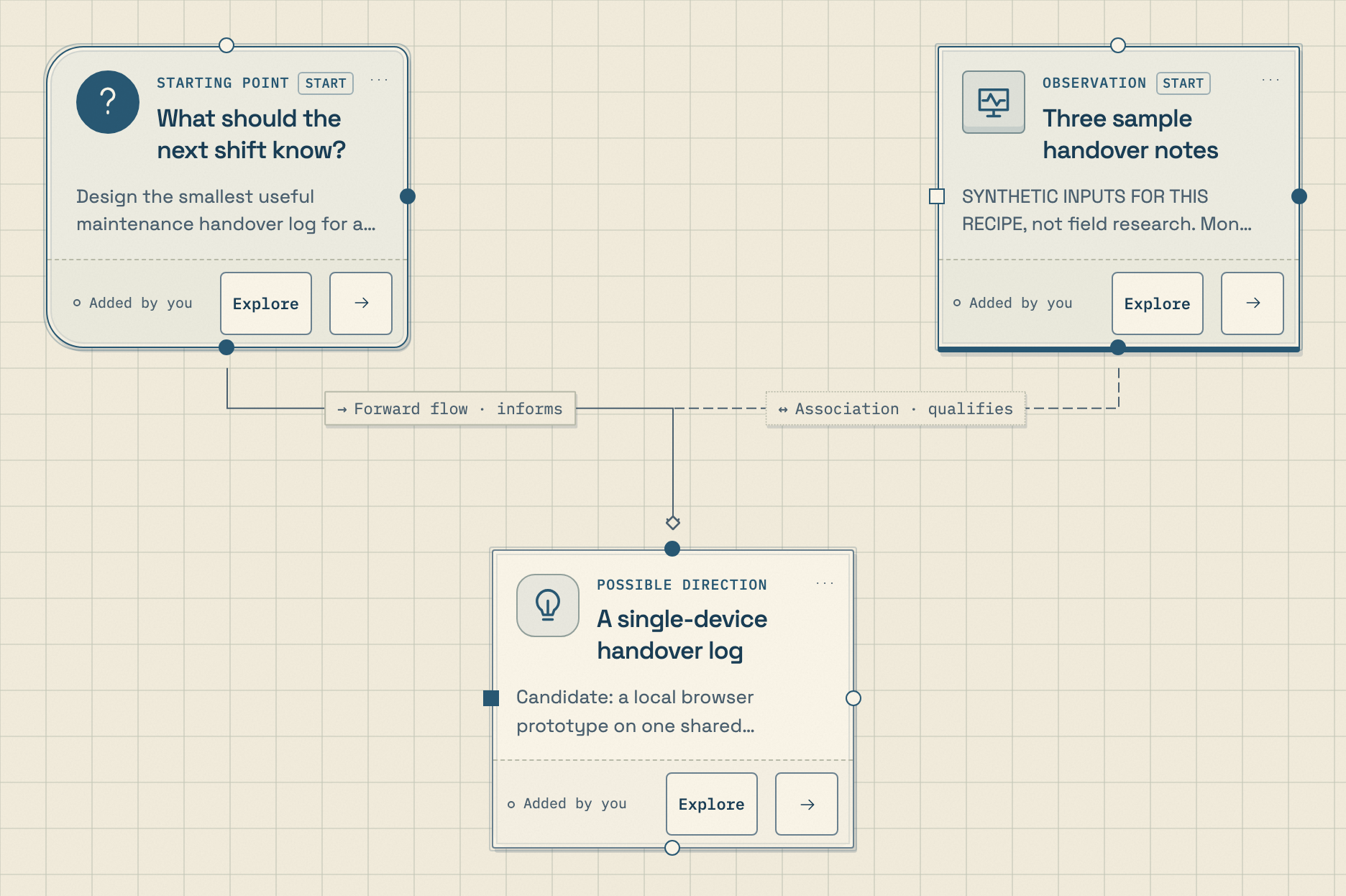
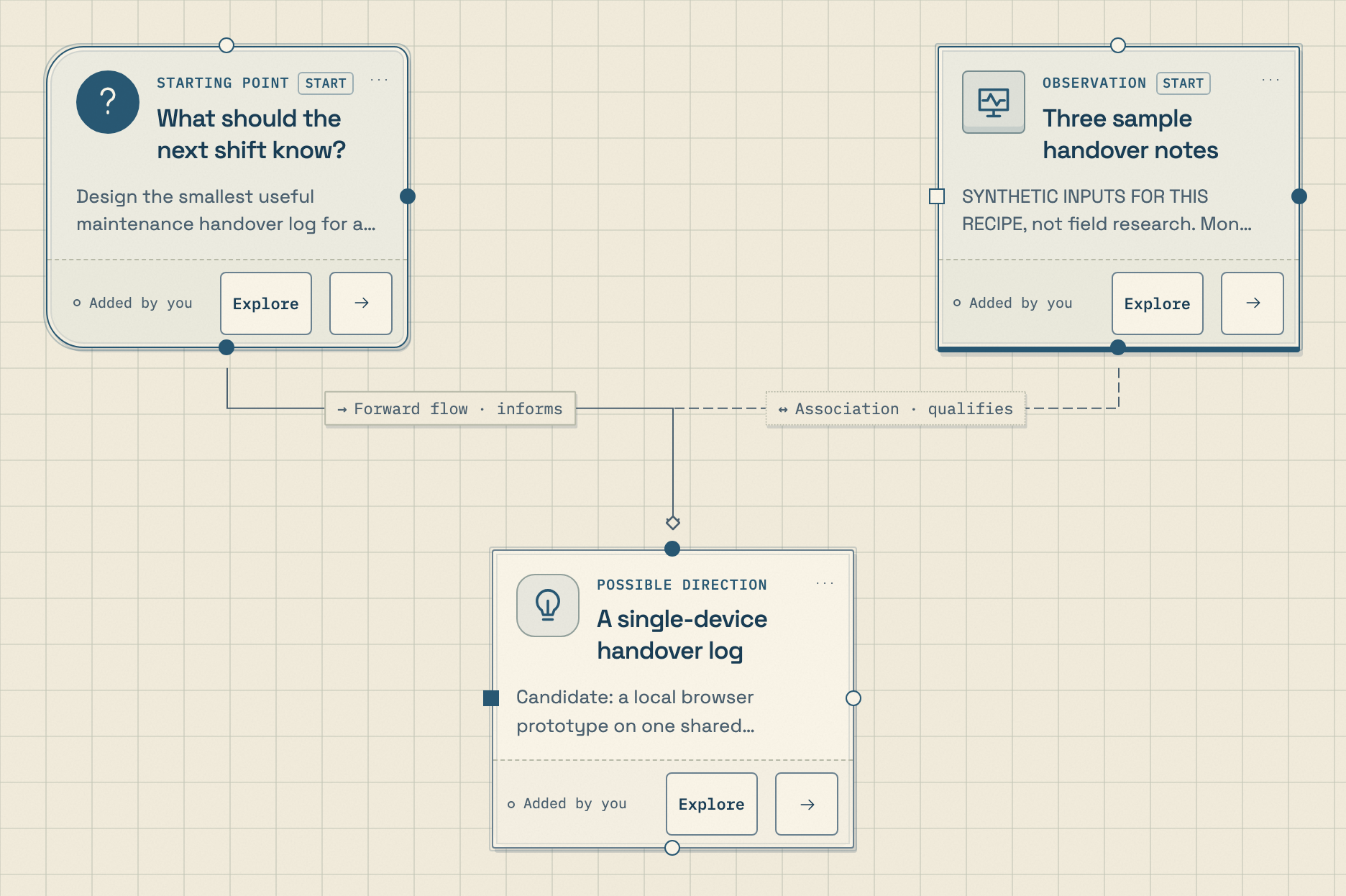
THE THREE-NODE INVESTIGATIONNATIVE Synatrail CARDS
Native Synatrail cards show how the workshop question informs the proposed log and how sample notes qualify it.
↳The original three cards, arranged in Synatrail with explanatory relationships added for this walkthrough. The recorded live run used these cards without saved edges.
01 / QUESTION

What should the next shift know?

Could a small shared maintenance handover log make unfinished work, responsibility and the next action clearer between shifts?

Sets the decision for the investigation.

02 / OBSERVATION

Three sample handover notes

A coolant drip, a chuck wobble and a repair awaiting review. The fictional notes name people, actions and unresolved work. They illustrate a workflow; they do not measure demand or savings.

Role: informs the question and constrains the idea.

03 / IDEA

A single-device handover log

One shared workshop tablet: record outstanding work, an owner, a next action and acknowledgement; export a backup. Compare it with a structured paper checklist. Operational decisions stay with the supervisor.

Role: proposes an answer, still to be tested.

  1. Create the three cards

    Open New investigation, name the project and set its question. Use the downloadable investigation record for the exact card text. Add only those three cards; keep responses in the conversation or notebook.

  2. Choose the scope

    The recorded live run selected the three cards together without saved edges. As an optional follow-up, connect the observation to the question and the idea to its context. Explain what each relationship supports and what remains unproven.

  3. Ask within the selection

    Select all three cards, check that the assistant scope names your selection, and use Ask. Request a decision, its basis and the cheapest next test. Keep automatic exploration paused for this bounded example.

  4. Review before packaging

    Synatrail can add its answer as a canvas card. To keep this example at three nodes, remove that extra card while retaining the saved conversation. Review the objections and open questions, then use recipe 06 to package the original three cards and the saved answer.

TRY THIS / ASK THE THREE CARDS
Using only these three cards, assess whether a workshop handover log is worth a small prototype. Separate supplied observations, assumptions and your inferences. Compare the idea with using a structured paper checklist. Give the smallest useful scope, the strongest reason to reject it, and one test with an observable pass/fail rule. Treat the example notes as synthetic. Do not claim interviews, savings or adoption that we have not measured.
ACTUAL RUN / 1 OCTOBER 2026

The recommendation: test the paper checklist first. The live answer proposed a two-week trial covering at least ten handovers before committing to software. It proposed targets of 90% complete entries, 80% of acknowledgements within fifteen minutes of shift start, and at most 10% ambiguous items. These are suggested pilot thresholds, not measured results.

The light package: three modules, six stories and six requirements for a local, single-device log. It remains a draft requiring review. No application was built and no comprehensive specification run was started.

What the reviewed revision addresses below: its first build wave says “parallel” although the brief asks for one builder and the UI depends on storage. Sequence storage before the UI. It also suggests local telemetry and a comparison view; decide whether those belong in the first version. A completed generation still needs this scope review.

Five live OpenAI API calls including connection checks · estimated provider cost US$0.043363. The final canvas contains exactly three nodes. The run record includes prompts, usage receipts and the removal of the automatically added answer card; the answer remains in the saved conversation.

The downloadable evidence and generated package are in English. The JSON is a readable record: recreate the three cards manually, as Synatrail has no canvas importer. The copyable prompts on this page are shorter adaptations; the exact live prompts are linked above.

Stop when: you can state what to test, why this evidence justifies that test, and what observation would reverse the decision. More cards are useful only if they can change one of those answers.

A stronger brief.
The same three nodes.

A second pass gives focused questions to the reviewers and reconciles their answers into a revised specification.

Focused tasksIntegrated review

The review focuses on five concrete decisions: sequence the build for one builder; keep acknowledgement separate from ownership; remove unnecessary telemetry; make backup and restore agree; and test whether software adds value beyond the paper checklist.
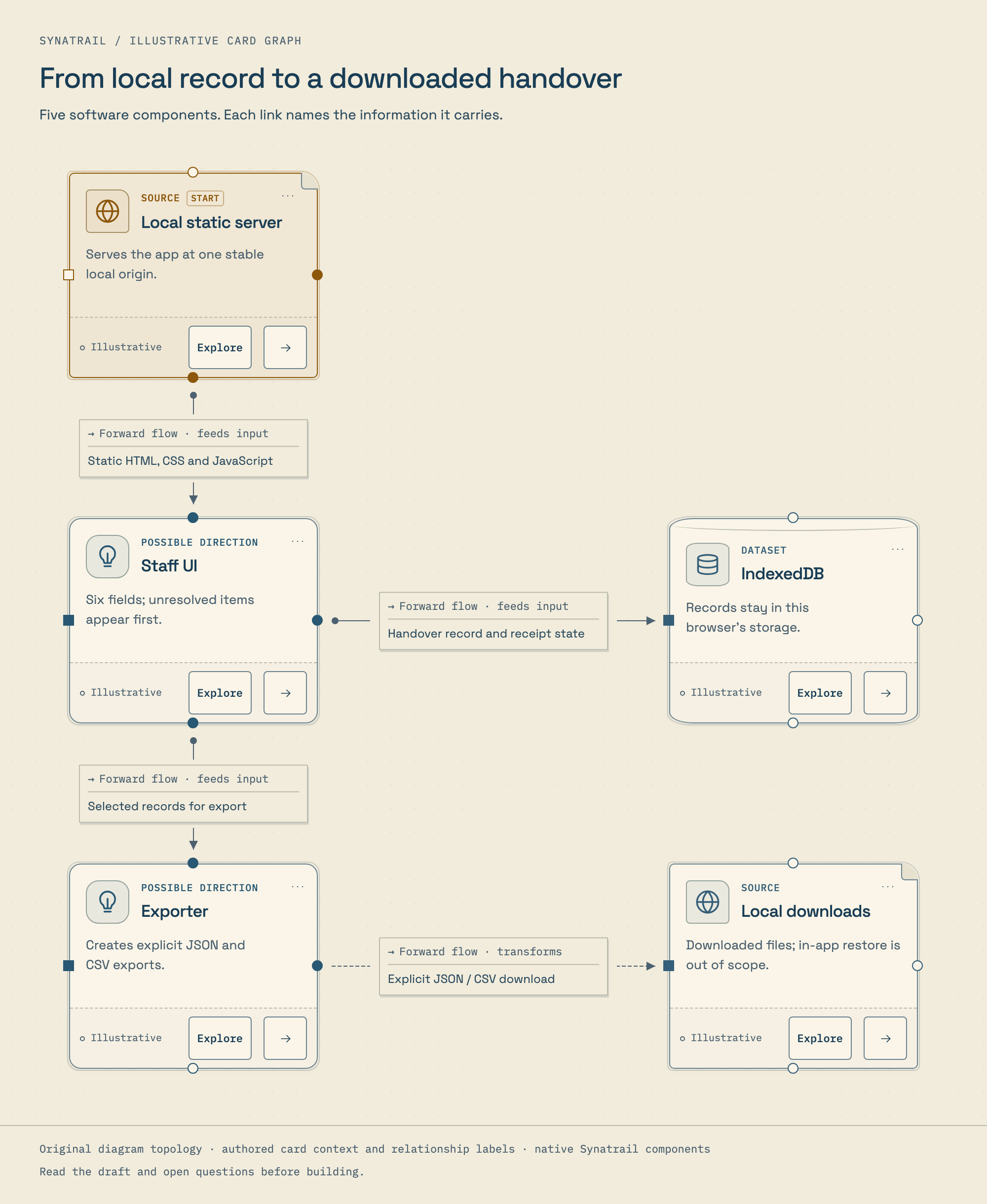
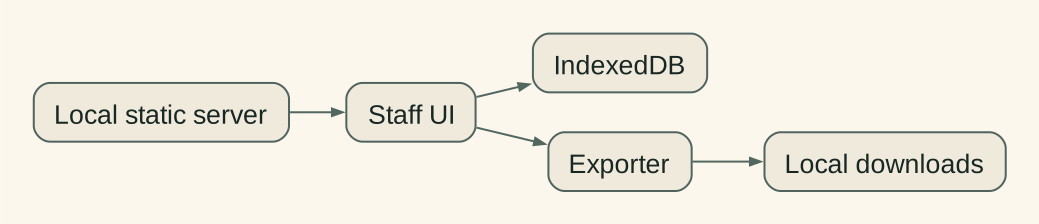
PROPOSED SOFTWARE ARCHITECTURENATIVE Synatrail CARDS
Five native Synatrail cards describe the local static server, staff UI, IndexedDB, exporter and local downloads. Links identify the data carried between them.
↳The revised architecture, presented with Synatrail cards and labeled data flows. Card context and link labels explain the exported design; the application has not been implemented.
3 nodesA question, supplied context and a candidate solution
3 modules · 6 storiesA light planning package with acceptance criteria
4 model callsPlans, worker outputs and final synthesis recorded
PACKAGE.md

Product specification

Download this document

The resulting light specification: scope, requirements, architecture, risks and the decisions still needing evidence.

Workshop Handover Log — Draft

A proposed single-device handover log, conditional on validating a structured paper process first.

Kind: software · Investigation: Workshop handover, reviewed by an orchestrator · Composed: 2026-10-01T19:54:43.304Z · Model details: see the original download

1. Problem space

Who: Staff and supervisor in the fictional two-shift workshop.

Pain: The synthetic notes illustrate ambiguity about ownership, next action and closure; they do not establish real-world demand or impact.

Context: Investigate the paper process before building software. Operational and safety decisions remain with the supervisor outside the app.

Evidence: handover-question What should the next shift know?; sample-handover Three sample handover notes; handover-concept A single-device handover log

2. Solution idea

If the paper-process gate passes, prototype a local browser log on one shared device. Capture six core fields, show unresolved items first, record receipt acknowledgements and export JSON and CSV.

Differentiators

  • One device and a fixed local application origin.
  • Acknowledgement records receipt without changing ownership.

Non-goals

  • No backend, cloud, accounts, sync, notifications, integrations, AI features, machine control, diagnosis or safety sign-off.
  • No telemetry, in-app paper-comparison view or JSON import/restore.

3. Concept

User journey

  1. Before a software build, a supervisor evaluates whether a structured six-field paper checklist produces usable handovers.
  2. If that gate passes, staff create or edit local items; the next shift sees unresolved items first and can acknowledge receipt.
  3. A supervisor exports records for external review. A later evaluation compares the prototype with the paper baseline before any broader commitment.

Success criteria

  • The paper gate has pre-agreed checks for field completeness and owner/next-action clarity; no outcome is assumed.
  • The proposed prototype passes persistence, ordering, acknowledgement and export checks on a selected device and browser.
  • A later, separately defined software-versus-paper comparison establishes whether software adds value.

4. Data

Entities

Entity Fields Source
handover_item item_id: generated identifier, equipment_label: required text, issue_short: required text, current_owner: required text, next_action: required text, status: open | awaiting_review | closed, timestamp: creation time, updated_at: last edit time, acknowledged_by: optional entered initials, acknowledged_at: optional receipt time Six core fields proposed in handover-concept; status and ownership ambiguity illustrated by synthetic sample-handover. Identifiers and metadata are design choices.

Evidence used as data

Evidence Use
handover-question What should the next shift know? Goal and validation question.
sample-handover Three sample handover notes Synthetic examples of handover ambiguity, not field research.
handover-concept A single-device handover log Candidate scope, fields, acknowledgement and exports.

5. Architecture

Proposed vanilla JavaScript UI and direct IndexedDB, with bundled static assets served on the shared device at http://localhost:4173. No external requests or backend.

Components

Component Responsibility Technology
Staff UI Create, edit, list and acknowledge items. HTML, CSS, vanilla JavaScript
Local store Persist records under the fixed origin. Direct IndexedDB API
Exporter Download outbound-only JSON and CSV. Browser Blob and download link
Local static server Serve bundled assets at the fixed origin. Device-local static HTTP server

Interfaces

From To Protocol Purpose
Staff UI Local store In-browser IndexedDB calls Read and write items.
Staff UI Exporter In-browser function call Produce local downloads.
Local static server Staff UI Loopback HTTP Serve bundled assets.

Deployment: Proposed fixed origin http://localhost:4173 on one shared device; choose the device, browser and local server before persistence testing. Initial loopback asset loads are expected; normal use makes no external requests.

6. Modules

Id Module Purpose Depends on
m1 Local records Schema, validation, persistence and unresolved-first query. —
m2 Handover UI Create, edit, list and acknowledge receipt. m1
m3 Outbound export Download complete JSON and readable CSV without import. m1, m2

7. Build waves

Wave 1 · Wave 1 — Records and UI (sequential)

After the paper gate, implement and check m1, then m2.

Modules: m1, m2

Wave 2 · Wave 2 — Export (sequential)

After Wave 1, implement m3 and check the integrated prototype.

Modules: m3

8. PRDs

m1

S1 · Save a six-field item

  • A valid item is saved at the fixed origin with generated item_id and timestamp.
  • Missing equipment label, issue, owner or next action is rejected.

S2 · Retrieve unresolved items first

  • Open and awaiting_review items appear before closed items; within each status, updated_at descending determines order.
  • Saved items remain available after browser restart at the same origin.
m2

S3 · Create and edit from the tablet UI

  • The form exposes equipment label, issue, owner, next action and status; timestamp is set by the app.
  • Editing an item updates updated_at and displays the saved values.

S4 · Acknowledge receipt

  • Acknowledging stores entered initials and acknowledged_at and displays both.
  • Comparing the stored record before and after acknowledgement shows current_owner and status unchanged.
m3

S5 · Export JSON

  • The downloaded JSON parses and contains every stored item and its metadata.
  • The UI offers no import or restore action; export is not presented as in-app recovery.

S6 · Export readable CSV

  • The CSV has one row per item and headers for item_id, the six core fields, updated_at, acknowledged_by and acknowledged_at.
  • A proposed check opens the download and verifies that commas, quotes and line breaks in entered text remain within their CSV fields.

Design system

  • Show unresolved work first.
  • Label owner and next action explicitly.
  • Keep receipt acknowledgement distinct from issue ownership.

Tone: Plain and non-authoritative about safety. · Colors: High-contrast dark text on a light backg · Typography: System font; tablet legibility requires prototype review.

Agent concurrency

Up to 1 builder(s) in parallel.

Shared files (serialize edits)

  • src/store.js
  • src/app.js
  • src/export.js

Rules

  • One builder at a time.
  • Complete Wave 1 before Wave 2.
  • Review changes to the record contract before dependent UI or export changes.

Controls and tests

Area Check Method
Paper gate Determine whether the structured paper checklist yields complete fields and unambiguous owners and next actions. Proposed supervised paper pilot; agree measures, duration and pass criteria before collecting outcomes.
Later value comparison Determine whether software improves on the validated paper baseline. After the paper gate and prototype, pre-agree comparable measures and evaluate both processes separately.
Persistence and origin Items survive browser restart and device power cycle at http://localhost:4173. Proposed manual check on the selected device and browser; record origin and compare stored items before and after.
Ordering and receipt Unresolved items lead; acknowledgement changes receipt metadata only. Proposed mixed-status UI check and before/after IndexedDB record comparison.
Export and network JSON parses, CSV columns and escaping are correct, and normal use makes no external requests. Proposed fixture checks and browser network inspection; allow initial loopback asset requests.

Dependencies

Dependency Kind Reason
IndexedDB standard Local persistence at the fixed browser origin.
Device-local static HTTP server service Provides a stable localhost application origin.

Risks

Risk Mitigation
Synthetic notes do not establish user demand or ergonomic suitability. Run the paper gate and review the prototype before adoption.
Changing origin or losing the single device may make records inaccessible; export cannot restore them in-app. Fix the origin, test on the chosen device and agree an external retention and recovery policy.
Shared-device acknowledgements may not reliably identify a person. Agree an initials and supervision policy outside the app.
Privacy and physical suitability of the tablet or paper checklist materials are unknown. Resolve handling, access, retention and physical-use questions before any supervised pilot.

Open questions

  • Which tablet, browser and local-server arrangement will be used?
  • Who enters acknowledgement initials, and how is ambiguity handled?
  • What are the device-unavailability, export-retention and recovery procedures?
  • What privacy rules govern names, issue descriptions and exported files?
  • What paper-checklist material and tablet placement are suitable?
  • What pre-agreed paper-gate criteria and later comparison method are acceptable?

Evidence

  • handover-question What should the next shift know?
  • sample-handover Three sample handover notes
  • handover-concept A single-device handover log

Recorded investigation basis

Frozen scope: my canvas revision 1

No linked decision is inferred; review the retained records before treating this draft as a commitment.

Selected concept

No selected named concept was present in the frozen package scope.

Human decision records

No selected human concept decision record.

Exact selected material
  • handover-question What should the next shift know? (content 1)
  • sample-handover Three sample handover notes (content 1)
  • handover-concept A single-device handover log (content 1)

Frozen specification

Export state: Needs review · Specification revision: 1

Specification digest: da945df18ef33c486d5a8016dfe1d97b066bcfae2cbaac190a180a66e41a432c

No human approval for handoff is recorded for this exact specification revision. Downloading or copying this export does not approve it.

R-001 · revision 1 · Needs review

Before software work, define and run a supervised structured-paper gate; assess software against paper only in a later, separate comparison.

Acceptance

  • Document the paper measures and pass criteria before the paper pilot.
  • Document a separate, pre-agreed software-versus-paper comparison before drawing a software value conclusion.

Decision records

No exact human decision record.

Evidence versions

  • canvas=my, nodeId=handover-question, contentRevision=1

Assumptions

  • No real pilot results are supplied.

Unresolved

  • Pilot duration, sample size and decision thresholds.
R-002 · revision 1 · Needs review

Store the six-field handover item locally on one device at the fixed application origin, without an external service.

Acceptance

  • Create an item and verify its six core fields in IndexedDB.
  • At the same origin, verify it remains after browser restart; inspect normal use for external requests.

Decision records

No exact human decision record.

Evidence versions

  • canvas=my, nodeId=handover-concept, contentRevision=1

Assumptions

  • The selected device can run a local static server and supports IndexedDB.

Unresolved

  • Target device and browser.
R-003 · revision 1 · Needs review

Present unresolved items first and allow creation, editing and receipt acknowledgement without transferring ownership.

Acceptance

  • A mixed-status fixture displays open and awaiting_review before closed.
  • Before/after record comparison confirms acknowledgement writes initials and time but leaves current_owner and status unchanged.

Decision records

No exact human decision record.

Evidence versions

  • canvas=my, nodeId=sample-handover, contentRevision=1
  • canvas=my, nodeId=handover-concept, contentRevision=1

Assumptions

  • Entered initials can be interpreted under an agreed workshop policy.

Unresolved

  • Acknowledgement identity policy.
R-004 · revision 1 · Needs review

Provide outbound JSON and readable CSV export; exclude JSON import and in-app restore.

Acceptance

  • Parse a downloaded JSON file and compare its records with the stored set.
  • Check CSV headers, row count and escaping against the same set.
  • Confirm there is no import or restore control or claim.

Decision records

No exact human decision record.

Evidence versions

  • canvas=my, nodeId=handover-concept, contentRevision=1

Assumptions

  • Supervisors can retain exports outside the app.

Unresolved

  • Export retention and recovery policy.
R-005 · revision 1 · Needs review

Keep the draft build to three modules, two sequential waves and one builder; exclude telemetry and an in-app paper-comparison view.

Acceptance

  • Review the plan for exactly three modules, six stories, two sequential waves and one builder.
  • Inspect proposed UI and checks for the absence of telemetry and a paper-comparison view.

Decision records

No exact human decision record.

Evidence versions

  • canvas=my, nodeId=handover-question, contentRevision=1

Assumptions

None.

Unresolved

None.

Exact reference availability
  • canvas=my, nodeId=handover-question, contentRevision=1 — current
  • canvas=my, nodeId=handover-concept, contentRevision=1 — current
  • canvas=my, nodeId=sample-handover, contentRevision=1 — current
Honest unresolved context

Contradictions, risks and missing evidence

  • Synthetic notes do not establish user demand or ergonomic suitability. — Run the paper gate and review the prototype before adoption.
  • Changing origin or losing the single device may make records inaccessible; export cannot restore them in-app. — Fix the origin, test on the chosen device and agree an external retention and recovery policy.
  • Shared-device acknowledgements may not reliably identify a person. — Agree an initials and supervision policy outside the app.
  • Privacy and physical suitability of the tablet or paper checklist materials are unknown. — Resolve handling, access, retention and physical-use questions before any supervised pilot.

Risks accepted for this exact handoff

None. This revision has no handoff approval.

Unanswered questions

  • Which tablet, browser and local-server arrangement will be used?
  • Who enters acknowledgement initials, and how is ambiguity handled?
  • What are the device-unavailability, export-retention and recovery procedures?
  • What privacy rules govern names, issue descriptions and exported files?
  • What paper-checklist material and tablet placement are suitable?
  • What pre-agreed paper-gate criteria and later comparison method are acceptable?
  • Pilot duration, sample size and decision thresholds.
  • Target device and browser.
  • Acknowledgement identity policy.
  • Export retention and recovery policy.

Assumptions

  • No real pilot results are supplied.
  • The selected device can run a local static server and supports IndexedDB.
  • Entered initials can be interpreted under an agreed workshop policy.
  • Supervisors can retain exports outside the app.

Requirements without an exact decision record

  • R-001
  • R-002
  • R-003
  • R-004
  • R-005

Pending claims / requirements awaiting human review

  • R-001
  • R-002
  • R-003
  • R-004
  • R-005

Some retained historical material is unavailable. Its frozen identifiers remain visible, but this export does not restore or disclose the unavailable private content.

prd/m1.md

Module requirements

Download this document

The generated implementation stories and their observable acceptance criteria.

PRD · Local records

Schema, validation, persistence and unresolved-first query.

S1 · Save a six-field item

Acceptance:

  • A valid item is saved at the fixed origin with generated item_id and timestamp.
  • Missing equipment label, issue, owner or next action is rejected.

S2 · Retrieve unresolved items first

Acceptance:

  • Open and awaiting_review items appear before closed items; within each status, updated_at descending determines order.
  • Saved items remain available after browser restart at the same origin.
prd/m2.md

Module requirements

Download this document

The generated implementation stories and their observable acceptance criteria.

PRD · Handover UI

Create, edit, list and acknowledge receipt. Depends on: m1

S3 · Create and edit from the tablet UI

Acceptance:

  • The form exposes equipment label, issue, owner, next action and status; timestamp is set by the app.
  • Editing an item updates updated_at and displays the saved values.

S4 · Acknowledge receipt

Acceptance:

  • Acknowledging stores entered initials and acknowledged_at and displays both.
  • Comparing the stored record before and after acknowledgement shows current_owner and status unchanged.
prd/m3.md

Module requirements

Download this document

The generated implementation stories and their observable acceptance criteria.

PRD · Outbound export

Download complete JSON and readable CSV without import. Depends on: m1, m2

S5 · Export JSON

Acceptance:

  • The downloaded JSON parses and contains every stored item and its metadata.
  • The UI offers no import or restore action; export is not presented as in-app recovery.

S6 · Export readable CSV

Acceptance:

  • The CSV has one row per item and headers for item_id, the six core fields, updated_at, acknowledged_by and acknowledged_at.
  • A proposed check opens the download and verifies that commas, quotes and line breaks in entered text remain within their CSV fields.
AGENTS.md

Instructions for the builder

Download this document

The order of work, concurrency rules and checks exported with this package.

AGENTS.md

You are building Workshop Handover Log — Draft (software). Read PACKAGE.md first; it is the complete product definition. Do not widen the scope beyond it.

Frozen specification revision 1 · Needs review. Downloading this archive did not approve it. Resolve every item marked unresolved or awaiting review instead of treating it as verified.

Order of work

  1. Wave 1 — Records and UI (sequential): prd/m1.md, prd/m2.md — After the paper gate, implement and check m1, then m2.
  2. Wave 2 — Export (sequential): prd/m3.md — After Wave 1, implement m3 and check the integrated prototype.

Concurrency

At most 1 builder(s) at once. Serialize edits to: src/store.js, src/app.js, src/export.js.

  • One builder at a time.
  • Complete Wave 1 before Wave 2.
  • Review changes to the record contract before dependent UI or export changes.

Definition of done

  • Paper gate: Determine whether the structured paper checklist yields complete fields and unambiguous owners and next actions. (Proposed supervised paper pilot; agree measures, duration and pass criteria before collecting outcomes.)
  • Later value comparison: Determine whether software improves on the validated paper baseline. (After the paper gate and prototype, pre-agree comparable measures and evaluate both processes separately.)
  • Persistence and origin: Items survive browser restart and device power cycle at http://localhost:4173. (Proposed manual check on the selected device and browser; record origin and compare stored items before and after.)
  • Ordering and receipt: Unresolved items lead; acknowledgement changes receipt metadata only. (Proposed mixed-status UI check and before/after IndexedDB record comparison.)
  • Export and network: JSON parses, CSV columns and escaping are correct, and normal use makes no external requests. (Proposed fixture checks and browser network inspection; allow initial loopback asset requests.)

Every story in prd/ must meet its acceptance criteria before the wave is complete. Ask a human when an open question in PACKAGE.md blocks a decision; do not guess.

findings.md

Investigation findings

Download this document

Read the worker findings and the reasoning behind the proposed product.

Workshop handover, reviewed by an orchestrator

Real model outputs from a bounded cookbook-only orchestration. All scenario inputs are synthetic.

Product scope and validation · focused review

  • Problem-and-scope brief (short): Two-shift small workshop suffers ambiguous ownership/next-action at handover. The minimal proposal is a single-device local handover log (six fields: equipment_label, issue_short, current_owner, next_action, status, timestamp) accessed on a shared tablet/browser, with an acknowledge action that records receipt (initials + timestamp) but does not change ownership, and JSON/CSV export for supervisor review. Software work is conditional on first validating a structured paper checklist process in a supervised pilot. Sample handover notes are SYNTHETIC and cannot substitute for field research.
  • Key constraints preserved from the three source cards: single-device, local-origin only (no backend/cloud/auth/notifications/integrations/AI/machine control), minimal six-field model, acknowledgement must only record receipt, and exports are local files. All pilot numbers and performance targets are PROPOSED, UNVALIDATED targets.
  • Noted contradictions in the supplied draft that must be resolved before work: the draft text lists Wave 1 as 'parallel' while agentConcurrency limits to one builder; the draft adds a pilot comparison view and 'local telemetry' in Module 3 even though scope instructions ask to remove telemetry and to separate paper-process validation from software-vs-paper comparison; the requirements mention JSON export and at times treat import/restore as optional — this is an explicit acceptance conflict (export does not imply a restore/restore promise unless chosen and acceptance criteria updated).
Recommendations
  • Decision gate A — Paper-process checklist validation (required before any software build): Run a supervised paper pilot to verify that a structured six-field laminated checklist can produce usable, consistent handover records.
    • Proposed/unvalidated pilot design: 2-week supervised pilot OR at least 10 handovers (whichever reaches target first); map each paper entry to the six fields; supervisor-led mapping sessions daily during pilot.
    • Proposed/unvalidated success criteria (labelled PROPOSED, UNVALIDATED): >=90% field completeness (all six fields filled), <=10% ambiguous owner/next-action cases, >=80% acknowledgements recorded within 15 minutes of shift start, supervisor confirms 1:1 map for >=90% sampled entries. These targets are draft and must be treated as unvalidated.
    • If Gate A passes, proceed to a tightly scoped software prototype decision gate. If Gate A fails, iterate the paper checklist (UX, field wording, placement) before considering software.
  • Decision gate B — Does software add measurable value over validated paper checklist?: Only considered after Gate A passes. Run a small software pilot on the same device using a local prototype and compare measured outcomes vs the validated paper baseline.
    • Proposed/unvalidated comparison metrics: completeness, owner/next-action ambiguity rate, acknowledgement latency, supervisor review time per handover, and error/merge incidents during handover. Define measurement method and sample size before the comparison. All numeric thresholds are proposed and unvalidated.
    • Software decision acceptance requires a pre-agreed improvement margin over paper (e.g., relative improvement in completeness or reduction in ambiguity) and evidence that single-device constraints (availability, origin stability) do not negate benefits.
  • Operational design choices to lock before any build: (1) Acknowledgement is explicitly defined as a receipt record only — it must never reassign ownership. (2) Export (JSON/CSV) is provided for backup and supervisor review; export does NOT imply automatic restore/import capability unless the team explicitly adds import with matching acceptance criteria. (3) Keep all development waves strictly sequential under one builder (no parallel builds touching shared schema/storage files). (4) Remove telemetry and the pilot comparison view from the first software iteration; comparison view can be a separate later module only after Gate A.
Concerns retained
  • Unresolved assumptions (preserve these as unresolved): exact tablet model and browser (affects IndexedDB behavior and touch layout); who will enter initials for acknowledgement and how identity ambiguity is resolved (initials vs full name); availability policy for the single shared device and human process for device unavailability; whether JSON import/restore is required (conflict in current drafts); supervisor acceptance criteria for a successful paper pilot and what sample size/timeframe stakeholders consider sufficient; real ergonomic needs of operators (no real user interviews have been done).
  • Scope exclusions (explicit, preserved): No backend/cloud/auth, no notifications, no integrations, no AI features, no machine control or safety sign-off within the app, no automated operational decisions; first software version excludes telemetry and the supervisor comparison view. These exclusions must remain unless stakeholders explicitly vote to expand scope after Gate A.
  • Export/restore concern: current materials mix export and optional import. Recommendation: treat export as outbound-only (no implied restore) for the prototype unless a separate explicit decision and acceptance tests add import/restore. If import is added later, add acceptance tests that explicitly verify restore correctness and document provenance/consent.
  • Process/organizational concern: single-device approach depends on device origin stability (same file/URL/origin). If browser origin changes (e.g., file:// vs http://, different base path), IndexedDB data may be siloed or lost; pick and freeze the device + origin before testing persistence.
  • Sequencing concern: ensure development waves are sequential and managed by one builder; current draft conflicting language (parallel vs single-builder) must be corrected before any development work starts.

Technical specification and consistency · focused review

  • Observations (synthetic inputs preserved): three source cards define a single-device local handover log, six core fields (equipment_label, issue_short, current_owner, next_action, status, timestamp) plus acknowledge metadata and exports; original draft added telemetry, an optional JSON import, a paper-comparison view and a parallel first wave—these conflict with steering constraints.
  • Design choices (explicit): use vanilla JavaScript, direct IndexedDB (no libraries), serve bundled static files at stable origin http://localhost:4173, single-device only, no external/network calls, unresolved-first ordering in UI, acknowledgement records receipt only (does NOT change current_owner), provide JSON and human-readable CSV export, explicitly exclude JSON import/restore from the product and remove all import acceptance checks, two sequential build waves under one builder, exclude telemetry and the paper-comparison view from delivered scope.
  • Untested assumptions (preserved unresolved): which tablet/browser will be used for the pilot (affects touch layout and IndexedDB behaviour); who exactly will enter initials for acknowledge and whether initials are sufficient to avoid ambiguity; device-availability policy and recovery process expectations; whether supervisor requires in-app restore (explicitly excluded) or will accept export-only backup.
  • Key explicit constraint: export-only does NOT imply in-app recovery. Exported files are backups for external/archive use; the app will not provide an import/restore acceptance path in this specification.
  • Deployment note: the app is a static SPA served from http://localhost:4173 on the shared device; all feature behaviour must be verifiable with devtools network panel showing zero outbound network requests during normal use.
Recommendations
  • Acceptance checks (testable, before pilot):
    1. Persistence: create three sample items (using UI), close and restart the browser on the device served from http://localhost:4173, verify all items persist and created_at/updated_at remain unchanged. (Manual)
    1. Unresolved-first ordering: with mixed-status items present, UI lists items with status open and awaiting_review before closed; within each status sort by updated_at descending. (Manual/automated UI check)
    1. Acknowledge behaviour: activating acknowledge prompts for initials, sets acknowledged_by and acknowledged_at, and does NOT modify current_owner or status fields. Verify stored record fields after acknowledge. (Manual/automated check against IndexedDB record)
    1. Export correctness: JSON export produces a single syntactically valid JSON file containing every handover_item record including created_at, updated_at and acknowledged_* fields; CSV export produces a human-readable file with a header row mapping the six core fields plus acknowledge metadata. Validate JSON.parse succeeds and CSV has expected column count. (Automated unit test + manual open)
    1. No import/restore acceptance: explicitly do NOT include any import or restore acceptance checks. Document that the app does not offer in-app JSON restore and that exports are archival only. (Documentation check)
    1. No-network rule: exercising full CRUD and export flows produces zero outbound network requests (devtools network panel shows none). (Manual check)
    1. Single-device deployment check: app served from http://localhost:4173 on the target device works offline (no network) and preserves data across browser restart and device power cycle. (Manual)
    1. Developer process: enforce single-builder rule and sequential waves: verify only one builder works at a time on sharedFiles (human review of Git history / gated merges). (Process check)
    1. Accessibility/ergonomics smoke: tablet-layout form fields are touch-sized, input validation enforces required fields and issue_short max length 140 characters. (Manual review)
  • Operational recommendations:
    • Keep paper-process pilot and its gate separate from any later software-vs-paper value comparison; run the supervised paper checklist pilot first (instructions documented) before committing to software changes.
    • Document export-only recovery clearly in user guidance and supervisor instructions; provide procedures for manual reconstruction if required.
    • Preserve unresolved assumptions; capture them in the pilot checklist as explicit questions to answer.
Concerns retained
  • Resolved draft conflicts (explicit):
    1. Wave sequencing conflict: original draft listed Wave 1 as 'parallel' while agentConcurrency allowed one builder. Resolved: two waves defined and strictly sequential; only one builder permitted at all times.
    1. Acknowledge semantics conflict: earlier text implied acknowledge might 'claim' ownership. Resolved: acknowledge records receipt only (acknowledged_by, acknowledged_at) and MUST NOT change current_owner or status; acceptance checks reflect this.
    1. Telemetry and paper-comparison conflict: module 3 previously added telemetry and a paper comparison view. Resolved: telemetry and the paper-comparison view are removed from the delivered scope and from acceptance criteria for both waves.
    1. JSON import/restore conflict: earlier stories alternately required and made import optional. Resolved: JSON import/restore is explicitly excluded; all import-related acceptance checks removed. Export remains available but is not a restore mechanism.
  • Remaining concerns / risks (untested):
    • Tablet/browser choice unknown: IndexedDB quirks vary by browser and platform; pilot must choose and record exact device and browser. (untested assumption)
    • Identity ambiguity: initials may be ambiguous; responsibility for resolving identity outside the app must be documented. (untested assumption)
    • Single-device failure mode: if the tablet is unavailable or origin changes (different hostname/port), data may be inaccessible; produce administrative recovery guidance. (operational risk)
    • Export-only limitation: excluding import makes in-app recovery impossible; supervisors must accept manual restore procedures or keep exported snapshots. This may affect willingness to adopt software.
    • Do not claim the app makes safety decisions; supervisors retain all operational authority outside the app.

Orchestrator conclusion

Integrated the workers into a conditional, unbuilt software draft. The three canvas cards are the only cited inputs; the handover notes are synthetic.

Agree the paper gate and operational policies before authorizing a prototype; no files were generated, code compiled or tests executed.

review-notes.md

Orchestrator review

Download this document

The orchestrator’s synthesis, corrections and unresolved questions, preserved with the output.

Orchestrator review

These decisions are the actual final orchestrator output. They describe a light draft, not a completed build or human handoff approval.

Integrated the workers into a conditional, unbuilt software draft. The three canvas cards are the only cited inputs; the handover notes are synthetic.

Accepted

  • Six core fields, unresolved-first display, local JSON/CSV export and receipt-only acknowledgement.
  • Vanilla JavaScript, direct IndexedDB and the proposed stable origin http://localhost:4173.
  • A paper-process gate before building and a separate, later software-versus-paper value comparison.

Changed

  • Replaced the draft's parallel first wave with two sequential waves under one builder.
  • Made JSON import/restore explicitly out of scope and removed its acceptance path.
  • Replaced the worker's styled Mermaid diagram with a simple flowchart using separate declarations and edges.
  • Omitted the worker's proposed pilot numbers: duration, sample size and thresholds need agreement rather than implied validation.

Rejected

  • Telemetry and an in-app paper-comparison view.
  • Any interpretation of acknowledgement as claiming or reassigning an issue.
  • Export as a promise of in-app recovery, or the software plan as safety approval.

Unresolved

  • Device, browser, origin operation and single-device availability.
  • Identity, privacy, retention and external recovery policies.
  • Paper pilot criteria, later comparison method and real ergonomic needs.
  • Physical suitability of tablet placement and paper-checklist materials; no hardware stand is specified or approved.

Next action

Agree the paper gate and operational policies before authorizing a prototype; no files were generated, code compiled or tests executed.

Execution: cookbook-runner. Focused review calls were reconciled into an integrated result. This recipe-specific API script does not claim that the native Synatrail UI provides this model split.

Editorial review after export

This section was authored separately after the provider responses. It does not change the generated package or claim model approval.

Timing: statements about no files being generated refer to implementation artifacts at the time of the model response. The cookbook runner subsequently exported the planning documents and source files linked here. No product implementation or physical test was performed. Any later diagram rendering or CAD compilation has its own separate evidence.

Inspect the inputs, model calls and cost

The inputs are synthetic teaching material. This run used the cookbook’s reproducible API runner; its model split is not a model-routing control in the current Synatrail interface. The package uses Synatrail’s normal export format. Canvas views use the original three cards, with layout and explanatory relationships added for this walkthrough. The architecture and process diagrams retain the exported topology; card summaries and link labels were added for readability. The original records and diagrams remain available.

4 API calls · US$0.090311 estimated token cost. Exact model identifiers remain in the downloadable execution record.

Compare with the original draft

The original generated documents

These are the actual outputs of the workshop example’s light product specification. Read the product definition, inspect each module’s stories, and see the instructions a builder receives.
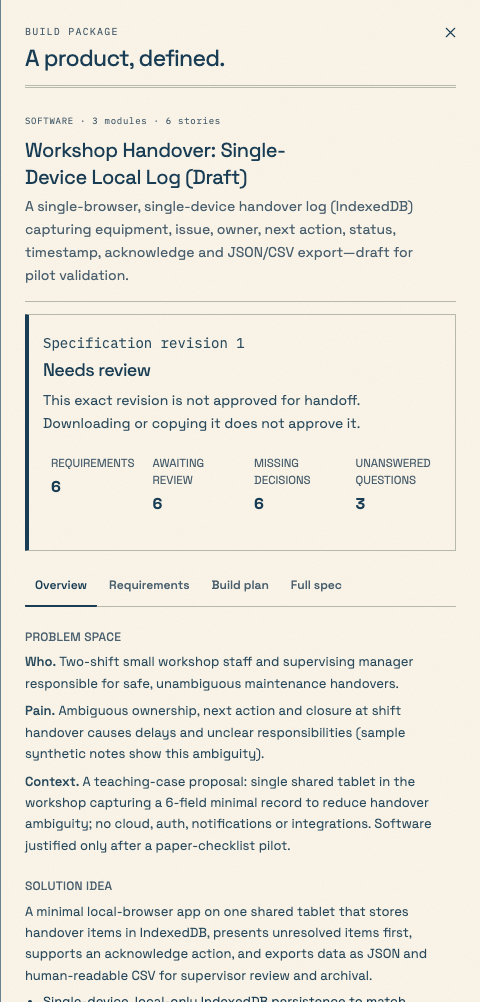
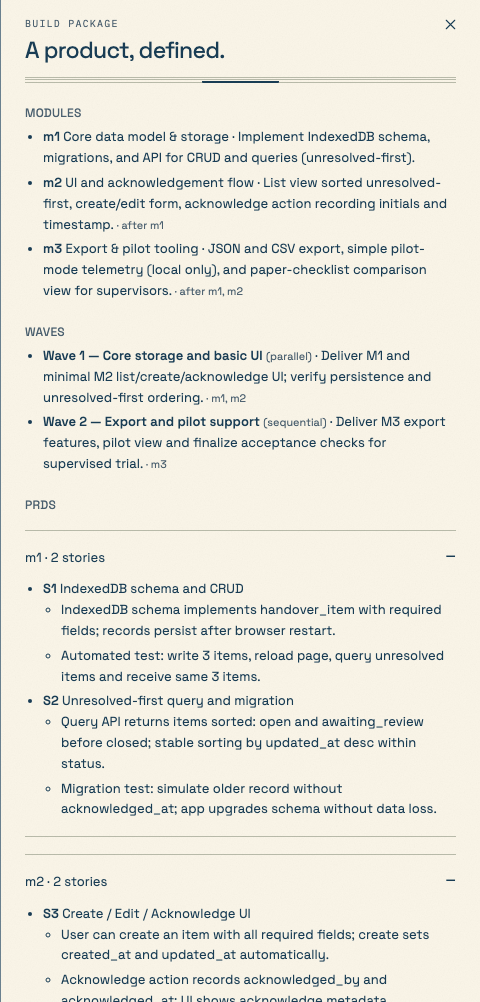
1 product specScope, architecture, requirements and unresolved decisions
3 module PRDsSix stories with observable acceptance criteria
Build instructionsOrder of work, concurrency and definition of done
IN SYNATRAIL / PACKAGE OVERVIEW
The actual generated Workshop Handover package open in Synatrail’s Overview tab.
↳The saved package in the real viewer: the problem, proposed solution and evidence behind it.
IN SYNATRAIL / BUILD PLAN
Synatrail’s Build plan tab showing the generated workshop handover modules and build waves.
↳The generated plan. Its first wave needs review: it says parallel while the brief specifies one builder.

The screenshots show the saved output restored locally in Synatrail. The documents below are rendered directly from the downloadable files, in their original English. The specification is an unapproved draft; the separately authored review notes explain what to resolve before building.

PACKAGE.md

Product specification

Download this document

The complete generated product definition, including scope, architecture, requirements, risks and open questions.

Workshop Handover: Single-Device Local Log (Draft)

A single-browser, single-device handover log (IndexedDB) capturing equipment, issue, owner, next action, status, timestamp, acknowledge and JSON/CSV export—draft for pilot validation.

Kind: software · Investigation: A clearer workshop handover · Composed: 2026-10-01T17:34:26.505Z · Model details: see the original download

1. Problem space

Who: Two-shift small workshop staff and supervising manager responsible for safe, unambiguous maintenance handovers.

Pain: Ambiguous ownership, next action and closure at shift handover causes delays and unclear responsibilities (sample synthetic notes show this ambiguity).

Context: A teaching-case proposal: single shared tablet in the workshop capturing a 6-field minimal record to reduce handover ambiguity; no cloud, auth, notifications or integrations. Software justified only after a paper-checklist pilot.

Evidence: handover-question What should the next shift know?; sample-handover Three sample handover notes; handover-concept A single-device handover log

2. Solution idea

A minimal local-browser app on one shared tablet that stores handover items in IndexedDB, presents unresolved items first, supports an acknowledge action, and exports data as JSON and human-readable CSV for supervisor review and archival.

Differentiators

  • Single-device, local-only IndexedDB persistence to match workshop constraints and privacy.
  • Strict six-field minimal model (equipment_label, issue_short, current_owner, next_action, status, timestamp) derived from the idea node.
  • Designed as a lightweight follow-up to a validated paper checklist; no integrations, auth, notifications or automated decisions.

Non-goals

  • No backend, cloud, authentication, sync, notifications, AI, machine control or integrations (explicit exclusion).
  • Does not include safety sign-off, automated fault diagnosis, or supervisor authority within the app.

3. Concept

User journey

  1. Shift-end operator opens the shared tablet app, creates or updates an item with required fields, app stores item to IndexedDB with system timestamp.
  2. Next-shift opens app; the UI sorts unresolved items first; operator can 'acknowledge' an item (records acknowledge timestamp and initials) or edit next_action and owner.
  3. Supervisor periodically exports JSON/CSV from the device and reviews externally; closure decisions are made outside the app.

Success criteria

  • App runs entirely in a modern Chromium-based mobile/desktop browser on a single shared device with local storage only.
  • IndexedDB persists entries across browser restarts and device power cycles on the same device and origin.
  • Exports produce a JSON file with full records and a readable CSV mapping the six fields plus acknowledge metadata.
  • UI orders unresolved items first and exposes an acknowledge action that records user-entered initials and timestamp.

4. Data

Entities

Entity Fields Source
handover_item item_id: uuid (system-generated), equipment_label: string (required), issue_short: string (<=140 chars, required), current_owner: string (initials or name, required), next_action: string (required), status: enum [open, awaiting_review, closed] (required), created_at: ISO8601 timestamp (system), updated_at: ISO8601 timestamp (system), acknowledged_by: string (optional initials), acknowledged_at: ISO8601 timestamp (optional) Derived from handover-concept and sample-handover

Evidence used as data

Evidence Use
handover-question What should the next shift know? Defines problem scope and validation goal
sample-handover Three sample handover notes Illustrates ambiguity and minimal fields needed
handover-concept A single-device handover log Specifies single-device constraint and required fields

5. Architecture

Single-page web app (PWA-lite not installed) running in-browser on a single shared device/origin, using IndexedDB (via Dexie.js) for persistence, vanilla JS or a compact framework (Svelte/Preact) for UI, CSV/JSON export to file, no network calls.

Components

Component Responsibility Technology
UI Shell Render list, item create/edit form, acknowledge action and export buttons; sort unresolved first Svelte or Preact, plain CSS
Local Storage Layer IndexedDB schema, CRUD, migrations, export serialization Dexie.js (or direct IndexedDB API)
Export/Serialization Produce JSON and human-readable CSV and trigger file download JSON.stringify, Blob, FileSaver.js or native anchor download

Interfaces

From To Protocol Purpose
UI Shell Local Storage Layer in-browser JS function calls / Promise API CRUD operations and queries (unresolved-first sort)
UI Shell Export/Serialization in-memory data serialization Export current dataset to JSON/CSV file

Deployment: Serve static HTML/CSS/JS files on the shared device filesystem or local file server; open index.html in a modern Chromium-based browser that supports IndexedDB.

6. Modules

Id Module Purpose Depends on
m1 Core data model & storage Implement IndexedDB schema, migrations, and API for CRUD and queries (unresolved-first). —
m2 UI and acknowledgement flow List view sorted unresolved-first, create/edit form, acknowledge action recording initials and timestamp. m1
m3 Export & pilot tooling JSON and CSV export, simple pilot-mode telemetry (local only), and paper-checklist comparison view for supervisors. m1, m2

7. Build waves

Wave 1 · Wave 1 — Core storage and basic UI (parallel)

Deliver M1 and minimal M2 list/create/acknowledge UI; verify persistence and unresolved-first ordering.

Modules: m1, m2

Wave 2 · Wave 2 — Export and pilot support (sequential)

Deliver M3 export features, pilot view and finalize acceptance checks for supervised trial.

Modules: m3

8. PRDs

m1

S1 · IndexedDB schema and CRUD

  • IndexedDB schema implements handover_item with required fields; records persist after browser restart.
  • Automated test: write 3 items, reload page, query unresolved items and receive same 3 items.

S2 · Unresolved-first query and migration

  • Query API returns items sorted: open and awaiting_review before closed; stable sorting by updated_at desc within status.
  • Migration test: simulate older record without acknowledged_at; app upgrades schema without data loss.
m2

S3 · Create / Edit / Acknowledge UI

  • User can create an item with all required fields; create sets created_at and updated_at automatically.
  • Acknowledge action records acknowledged_by and acknowledged_at; UI shows acknowledge metadata.
  • Manual checklist comparison: map a paper checklist entry to a saved item in-app and verify fields align.

S4 · Local usage ergonomics

  • On-screen form uses compact inputs suitable for tablet; required fields validated client-side.
  • List view shows clear indicators for status and owner initials.
m3

S5 · JSON export

  • Export produces a single JSON file containing all handover_item records including metadata (created_at, updated_at, acknowledged_*).
  • Downloaded JSON loads back into the app when re-imported (file-based import optional for recovery).

S6 · CSV export and pilot view

  • Export produces a readable CSV mapping six core fields plus acknowledge metadata; column headers are human-readable.
  • Pilot view shows side-by-side mapping with the one-page paper checklist fields for supervisor comparison.

Design system

  • Minimal: show only required fields and unresolved items up-front.
  • Robust: work offline and tolerate abrupt app/browser restarts.
  • Transparent: exports are human-readable and directly comparable to the paper checklist.

Tone: Plain, high-contrast, legible for workshop lighting · Colors: High-contrast text (dark on light), stat · Typography: System UI fonts, large touch targets for tablet use

Agent concurrency

Up to 1 builder(s) in parallel.

Shared files (serialize edits)

  • schema/indexeddb-schema.json
  • data-model/handover_item.json
  • storage/migrations.js

Rules

  • Only one builder agent works at a time (serial).
  • All edits to sharedFiles must be done serially and reviewed by a human before committing.
  • Feature branches are allowed but merges touching sharedFiles require explicit human merge and sanity check on migration tests.

Controls and tests

Area Check Method
Persistence Records persist across browser restart and device power cycle on the same origin Manual test: create items, close browser, restart, verify items present
Export JSON and CSV exports contain all fields and are syntactically valid Automated unit test for JSON validity and CSV header/row counts; manual open of CSV in spreadsheet
Ordering and ACK UI lists unresolved items first and acknowledge records initials+timestamp End-to-end manual verification with sample dataset (three items) and UI observation
Paper comparison App fields map 1:1 to the laminated paper checklist Supervisor-led mapping session: take 5 recent paper checklist entries and confirm mapping to in-app items

Dependencies

Dependency Kind Reason
Dexie.js library Simplifies IndexedDB schema/migrations and is lightweight for single-device apps
FileSaver.js or native Blob download library Triggering reliable client-side file downloads for JSON/CSV

Risks

Risk Mitigation
No real users interviewed; app may not match real ergonomic needs. Run short supervised pilot using paper checklist mapping before software pilot; keep UI minimal and iterate.
Single-device usage can fail if tablet is unavailable or browser origin changes. Provide clear device usage policy and local backup via manual JSON export; test recovery via import.

Open questions

  • What exact tablet model and browser will be used in pilot (affects touch layout and IndexedDB behavior)?
  • Who will enter initials for acknowledge action and how will identity ambiguity be handled (initials vs full name)?
  • What duration/size of supervised pilot is considered sufficient by stakeholders to decide for a software build?

Evidence

  • handover-question What should the next shift know?
  • sample-handover Three sample handover notes
  • handover-concept A single-device handover log

Recorded investigation basis

Frozen scope: my canvas revision 2

No linked decision is inferred; review the retained records before treating this draft as a commitment.

Selected concept

No selected named concept was present in the frozen package scope.

Human decision records

No selected human concept decision record.

Exact selected material
  • handover-question What should the next shift know? (content 1)
  • sample-handover Three sample handover notes (content 1)
  • handover-concept A single-device handover log (content 1)

Frozen specification

Export state: Needs review · Specification revision: 1

Specification digest: 5aeb57870ef9f453f68a5acc3b21d64a8aab07a0981f76d2c37dd0a2f5ac2058

No human approval for handoff is recorded for this exact specification revision. Downloading or copying this export does not approve it.

R-001 · revision 1 · Needs review

Implement a local-only handover_item schema in IndexedDB with the six fields (equipment_label, issue_short, current_owner, next_action, status, timestamp) plus acknowledge metadata; no network calls.

Acceptance

  • IndexedDB contains handover_item records with required fields and acknowledge metadata.
  • No outbound network/XHR/fetch calls are made during normal CRUD operations (validated via devtools network tab).

Decision records

No exact human decision record.

Evidence versions

  • canvas=my, nodeId=handover-question, contentRevision=1
  • canvas=my, nodeId=sample-handover, contentRevision=1
  • canvas=my, nodeId=handover-concept, contentRevision=1

Assumptions

None.

Unresolved

None.

R-002 · revision 1 · Needs review

App UI must display unresolved items first and allow create/edit of the six-field model and an acknowledge action that records initials and timestamp.

Acceptance

  • List view sorts unresolved statuses (open, awaiting_review) above closed and shows updated_at ordering within each status.
  • Acknowledge action prompts for initials and stores acknowledged_by and acknowledged_at.

Decision records

No exact human decision record.

Evidence versions

  • canvas=my, nodeId=handover-question, contentRevision=1
  • canvas=my, nodeId=sample-handover, contentRevision=1
  • canvas=my, nodeId=handover-concept, contentRevision=1

Assumptions

None.

Unresolved

None.

R-003 · revision 1 · Needs review

Provide JSON and human-readable CSV export of the full dataset, downloadable from the device without network usage.

Acceptance

  • Exported JSON is a valid JSON file containing all handover_item records.
  • Exported CSV has headers mapping to core fields and can be opened in a spreadsheet application.

Decision records

No exact human decision record.

Evidence versions

  • canvas=my, nodeId=handover-question, contentRevision=1
  • canvas=my, nodeId=sample-handover, contentRevision=1
  • canvas=my, nodeId=handover-concept, contentRevision=1

Assumptions

None.

Unresolved

None.

R-004 · revision 1 · Needs review

The system must be single-device and local-origin only: deploy as static files to the device and require no backend or cloud services.

Acceptance

  • All functionality works with files served from local filesystem or static server and without network connectivity.
  • Devtools network panel shows zero network requests during normal use (except optional manual export/import file reads).

Decision records

No exact human decision record.

Evidence versions

  • canvas=my, nodeId=handover-question, contentRevision=1
  • canvas=my, nodeId=sample-handover, contentRevision=1
  • canvas=my, nodeId=handover-concept, contentRevision=1

Assumptions

None.

Unresolved

None.

R-005 · revision 1 · Needs review

The build must include a supervisor-facing paper-checklist comparison view and instructions to run a supervised pilot before committing to broader software development.

Acceptance

  • UI exposes a pilot view that maps in-app fields to the one-page laminated checklist format.
  • Documentation includes clear pilot instructions: how to run the paper-checklist mapping session and record outcomes locally.

Decision records

No exact human decision record.

Evidence versions

  • canvas=my, nodeId=handover-question, contentRevision=1
  • canvas=my, nodeId=sample-handover, contentRevision=1
  • canvas=my, nodeId=handover-concept, contentRevision=1

Assumptions

None.

Unresolved

None.

R-006 · revision 1 · Needs review

Provide developer controls and tests proving persistence, export correctness, unresolved-first ordering and acknowledge behavior before pilot start.

Acceptance

  • Automated and manual tests cover persistence, export validity, ordering and acknowledge metadata; report produced before pilot.
  • AgentConcurrency rules enforced: single-builder merge for shared schema/storage files.

Decision records

No exact human decision record.

Evidence versions

  • canvas=my, nodeId=handover-question, contentRevision=1
  • canvas=my, nodeId=sample-handover, contentRevision=1
  • canvas=my, nodeId=handover-concept, contentRevision=1

Assumptions

None.

Unresolved

None.

Exact reference availability
  • canvas=my, nodeId=handover-question, contentRevision=1 — current
  • canvas=my, nodeId=sample-handover, contentRevision=1 — current
  • canvas=my, nodeId=handover-concept, contentRevision=1 — current
Honest unresolved context

Contradictions, risks and missing evidence

  • No real users interviewed; app may not match real ergonomic needs. — Run short supervised pilot using paper checklist mapping before software pilot; keep UI minimal and iterate.
  • Single-device usage can fail if tablet is unavailable or browser origin changes. — Provide clear device usage policy and local backup via manual JSON export; test recovery via import.

Risks accepted for this exact handoff

None. This revision has no handoff approval.

Unanswered questions

  • What exact tablet model and browser will be used in pilot (affects touch layout and IndexedDB behavior)?
  • Who will enter initials for acknowledge action and how will identity ambiguity be handled (initials vs full name)?
  • What duration/size of supervised pilot is considered sufficient by stakeholders to decide for a software build?

Assumptions

None.

Requirements without an exact decision record

  • R-001
  • R-002
  • R-003
  • R-004
  • R-005
  • R-006

Pending claims / requirements awaiting human review

  • R-001
  • R-002
  • R-003
  • R-004
  • R-005
  • R-006
prd/m1.md

PRD 1 · Data and storage

Download this document

Two stories for the local data model, persistence, ordering and migration, with the acceptance criteria the model produced.

PRD · Core data model & storage

Implement IndexedDB schema, migrations, and API for CRUD and queries (unresolved-first).

S1 · IndexedDB schema and CRUD

Acceptance:

  • IndexedDB schema implements handover_item with required fields; records persist after browser restart.
  • Automated test: write 3 items, reload page, query unresolved items and receive same 3 items.

S2 · Unresolved-first query and migration

Acceptance:

  • Query API returns items sorted: open and awaiting_review before closed; stable sorting by updated_at desc within status.
  • Migration test: simulate older record without acknowledged_at; app upgrades schema without data loss.
prd/m2.md

PRD 2 · Interface and acknowledgement

Download this document

Two stories for creating and editing items and recording the incoming shift’s acknowledgement.

PRD · UI and acknowledgement flow

List view sorted unresolved-first, create/edit form, acknowledge action recording initials and timestamp. Depends on: m1

S3 · Create / Edit / Acknowledge UI

Acceptance:

  • User can create an item with all required fields; create sets created_at and updated_at automatically.
  • Acknowledge action records acknowledged_by and acknowledged_at; UI shows acknowledge metadata.
  • Manual checklist comparison: map a paper checklist entry to a saved item in-app and verify fields align.

S4 · Local usage ergonomics

Acceptance:

  • On-screen form uses compact inputs suitable for tablet; required fields validated client-side.
  • List view shows clear indicators for status and owner initials.
prd/m3.md

PRD 3 · Export and pilot

Download this document

Two stories for exports and pilot support. The review notes question whether all of this belongs in the first version.

PRD · Export & pilot tooling

JSON and CSV export, simple pilot-mode telemetry (local only), and paper-checklist comparison view for supervisors. Depends on: m1, m2

S5 · JSON export

Acceptance:

  • Export produces a single JSON file containing all handover_item records including metadata (created_at, updated_at, acknowledged_*).
  • Downloaded JSON loads back into the app when re-imported (file-based import optional for recovery).

S6 · CSV export and pilot view

Acceptance:

  • Export produces a readable CSV mapping six core fields plus acknowledge metadata; column headers are human-readable.
  • Pilot view shows side-by-side mapping with the one-page paper checklist fields for supervisor comparison.
AGENTS.md

Instructions for the builder

Download this document

The generated order of work, shared-file rules and definition of done supplied with the specification.

AGENTS.md

You are building Workshop Handover: Single-Device Local Log (Draft) (software). Read PACKAGE.md first; it is the complete product definition. Do not widen the scope beyond it.

Frozen specification revision 1 · Needs review. Downloading this archive did not approve it. Resolve every item marked unresolved or awaiting review instead of treating it as verified.

Order of work

  1. Wave 1 — Core storage and basic UI (parallel): prd/m1.md, prd/m2.md — Deliver M1 and minimal M2 list/create/acknowledge UI; verify persistence and unresolved-first ordering.
  2. Wave 2 — Export and pilot support (sequential): prd/m3.md — Deliver M3 export features, pilot view and finalize acceptance checks for supervised trial.

Concurrency

At most 1 builder(s) at once. Serialize edits to: schema/indexeddb-schema.json, data-model/handover_item.json, storage/migrations.js.

  • Only one builder agent works at a time (serial).
  • All edits to sharedFiles must be done serially and reviewed by a human before committing.
  • Feature branches are allowed but merges touching sharedFiles require explicit human merge and sanity check on migration tests.

Definition of done

  • Persistence: Records persist across browser restart and device power cycle on the same origin (Manual test: create items, close browser, restart, verify items present)
  • Export: JSON and CSV exports contain all fields and are syntactically valid (Automated unit test for JSON validity and CSV header/row counts; manual open of CSV in spreadsheet)
  • Ordering and ACK: UI lists unresolved items first and acknowledge records initials+timestamp (End-to-end manual verification with sample dataset (three items) and UI observation)
  • Paper comparison: App fields map 1:1 to the laminated paper checklist (Supervisor-led mapping session: take 5 recent paper checklist entries and confirm mapping to in-app items)

Every story in prd/ must meet its acceptance criteria before the wave is complete. Ask a human when an open question in PACKAGE.md blocks a decision; do not guess.

COOKBOOK-REVIEW.md

Review of the generated draft

Download this document

Separately authored review notes: the scope and acceptance conflicts to resolve before handing the draft to a builder.

What to review before using this light package

The linked package is the real model output, preserved as an unapproved draft. These are editorial review notes; they are not extra provider findings or implemented changes.

These observations concern the recorded 2026-10-01 example. On a new reproduction, check each observation against the new output before using it. The companion archive adds this note as COOKBOOK-REVIEW.md; it does not alter the seven generated package files or approve the specification.

  1. Keep the build sequential. The brief requested two sequential waves and one builder. The draft labels its first wave parallel while its concurrency section permits only one builder. Resolve that conflict before handing it to a builder.
  2. Separate acknowledgement from ownership. The answer uses “acknowledges (claims)”. Acknowledging that a handover was read should not silently reassign the issue owner. Choose the exact behaviour and acceptance check.
  3. Keep the first version small. The generated third module adds a pilot comparison view and local telemetry. Those additions need review against the six-field log and export scope; they are not established user needs.
  4. Decide how recovery works. One story expects a JSON export to load back into the app while describing import as optional. Decide whether restore belongs in the prototype, then make the requirement and acceptance check agree. Choose the device, browser and stable application address before testing persistence.
  5. Measure the value of software separately. The model proposed a two-week paper pilot with at least ten handovers, 90% field completeness, 80% acknowledgement within fifteen minutes and at most 10% ambiguity. These are proposed pilot targets. Meeting them would show that the structured process can work; it would not establish that software improves on paper. Compare both before committing to a build.

Suggested next steering prompt:

Revise this draft only. Keep one builder and make both waves sequential. Define acknowledgement as recording receipt, without changing the owner. Remove telemetry and the comparison view from the first version. Resolve the optional-import acceptance conflict explicitly. Separate the paper-process gate from a later software-versus-paper comparison. Keep the three original source cards, preserve every unresolved assumption, and do not start a build or a commissioned package run.

This revision prompt is an example for the reader. It was not submitted as another paid call in the recorded run.

Synatrail automatically adds a scoped answer to the canvas. For this example its answer card was removed with the normal graph edit, retaining the full saved conversation and receipt. The final investigation has the original three nodes. The first scope review saw that temporary answer card; the package itself used only the three selected input cards plus the saved answer. The reproducible script now removes the answer card immediately after the answer is saved.

A manual mechanism.
Interdependent parts.

An adjustable inspection fixture adds geometry and motion to the design problem. Focused reviews examine guide rods, jaws, a screw and assembly checks, then reconcile the findings into one light package.

Focused tasksIntegrated review

Three nodes: the holding problem, a dimensional contract and the proposed manual fixture. The 240 × 180 mm base supports two guide rods, fixed and moving jaws, pads, bushings and a hand-adjusted screw.

Steer the work: make workers check the interfaces between parts. The workers found that moving the jaw 60 mm in the opening direction would hit the end support. The review preserved the conflict as an unresolved design decision instead of silently changing the dimensions.
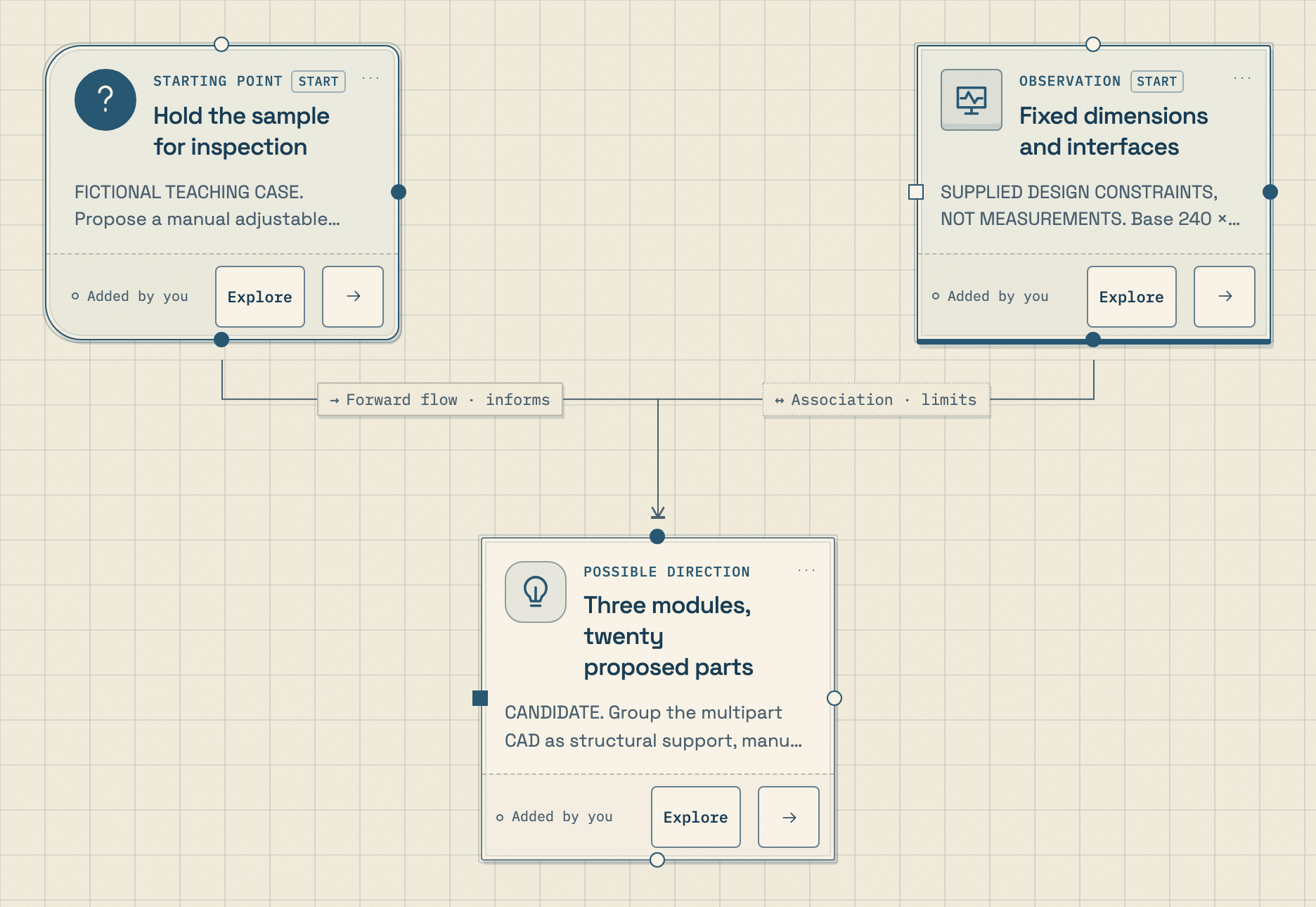
THE THREE-NODE HARDWARE CANVASNATIVE Synatrail CARDS
The real Synatrail canvas showing the fixture question, fixed dimensional context and multipart mechanism concept.
↳The original three cards, connected in Synatrail for this walkthrough: the question informs the concept, and the dimensional contract limits it.
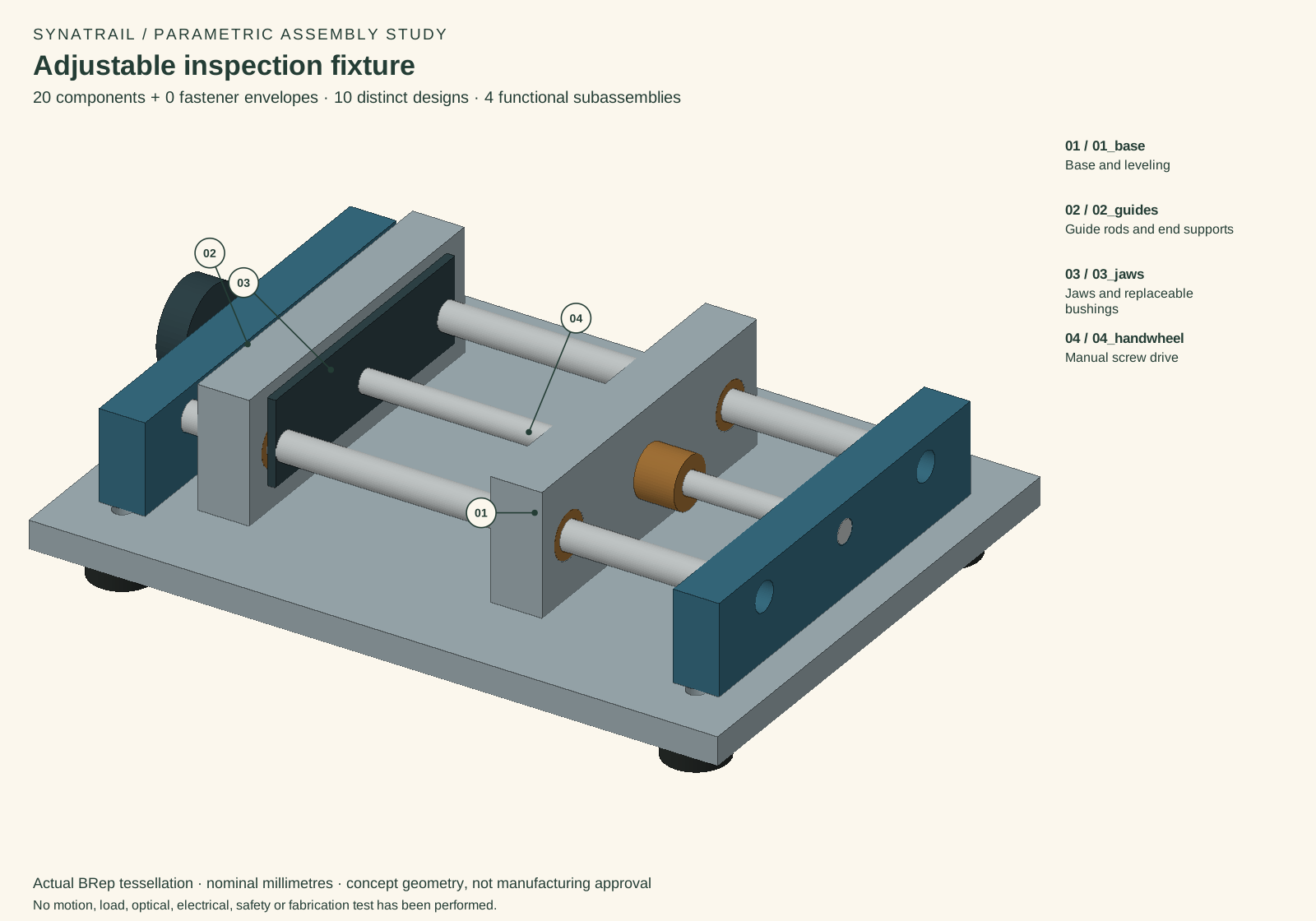
ASSEMBLED MECHANISMPRODUCED ARTIFACT
CAD assembly of an adjustable bench fixture with two guide rods, fixed and moving jaws, a manual screw and a hand knob.
↳Actual CAD geometry compiled from the reviewed parameter contract. Physical fit, clamping force and repeatability remain proposed tests.
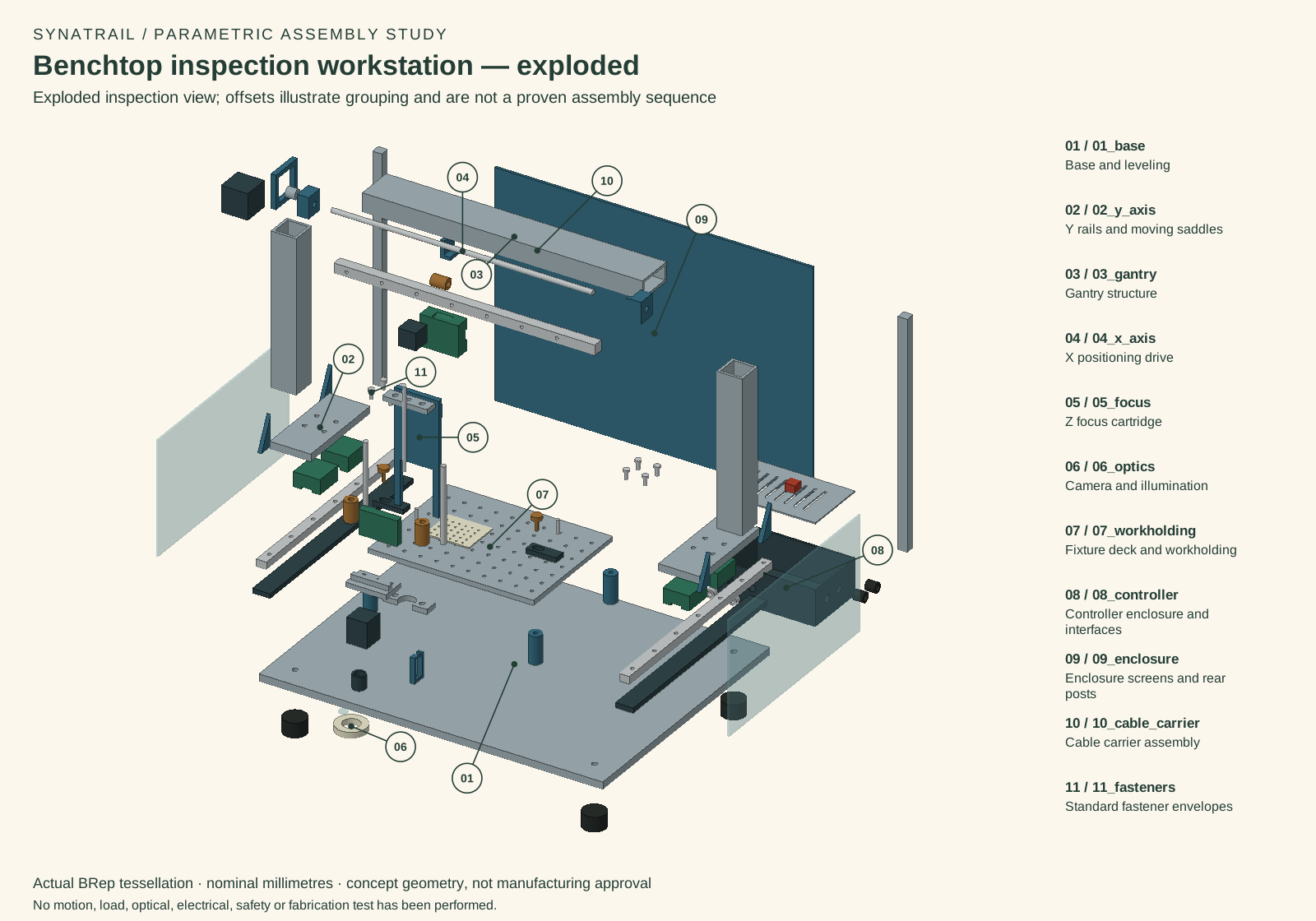
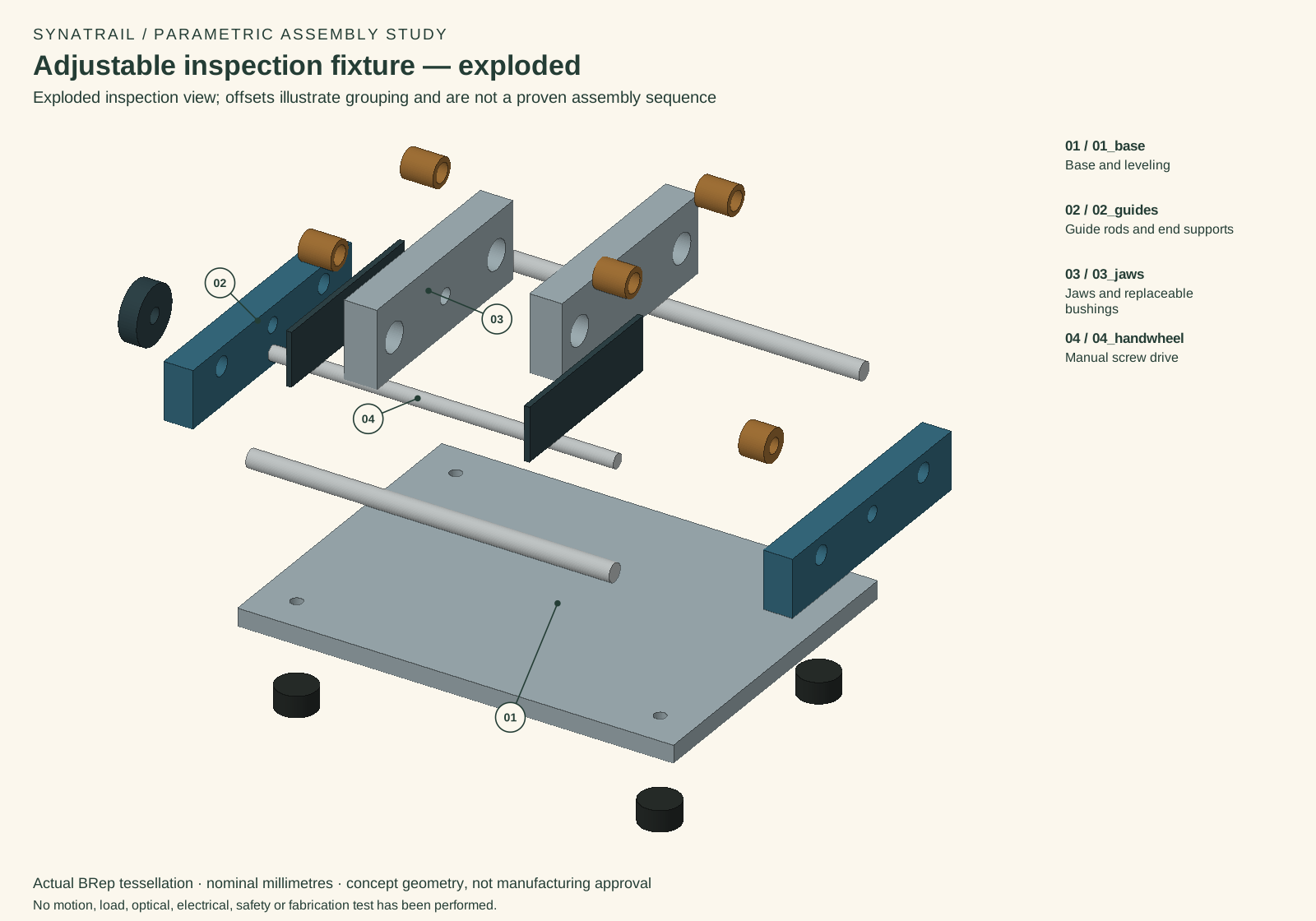
EXPLODED ASSEMBLYPRODUCED ARTIFACT
Exploded CAD view of the fixture showing the base, support plates, rods, jaws, pads, screw, knob and feet.
↳Separating the parts makes their roles and assembly relationships visible.
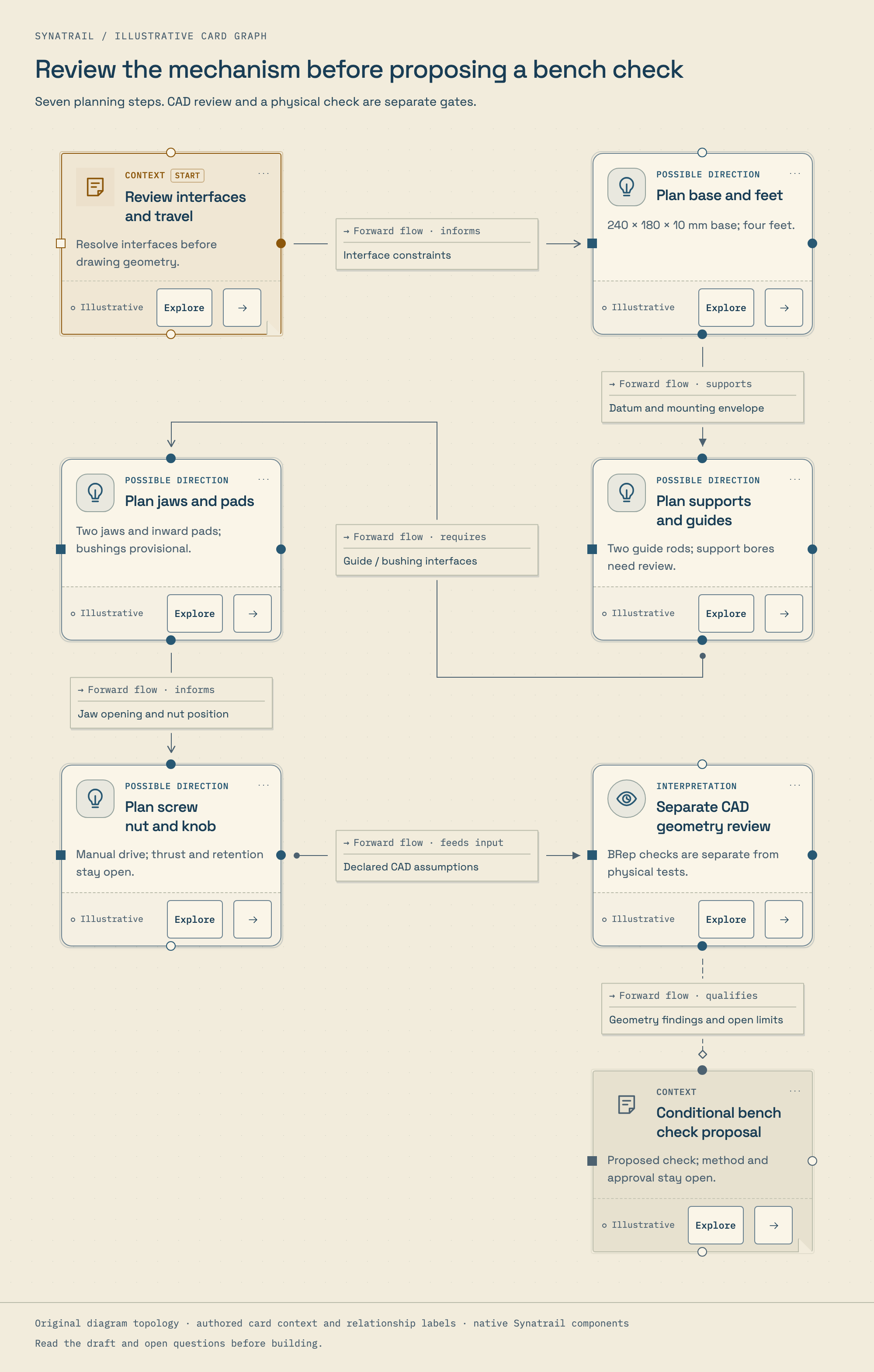
ASSEMBLY AND CHECK FLOWNATIVE Synatrail CARDS
Generated assembly and proposed inspection flow for the adjustable fixture.
↳Native Synatrail cards show the assembly sequence. Link labels identify the constraints and design information passed into each step; geometry review and proposed physical checks remain separate.
3 nodesA question, supplied context and a candidate solution
3 modules · 6 storiesA light planning package with acceptance criteria
4 model callsPlans, worker outputs and final synthesis recorded
PACKAGE.md

Product specification

Download this document

The resulting light specification: scope, requirements, architecture, risks and the decisions still needing evidence.

Adjustable bench inspection fixture — LIGHT review

A proposed manually adjusted fixture for positioning a de-energized sample during bench inspection.

Kind: hardware · Investigation: Adjustable bench inspection fixture · Composed: 2026-10-01T21:14:55.266Z · Model details: see the original download

1. Problem space

Who: A person conducting a proposed bench inspection.

Pain: A small sample may need positioning and visual access; repeatability and holding performance have not been established.

Context: Fictional teaching case. The supplied mechanical parameters are design constraints, not measured geometry or evidence of a working fixture.

Evidence: fixture-question Hold the sample for inspection; fixture-dimensions Fixed dimensions and interfaces; fixture-concept Three modules, twenty proposed parts

2. Solution idea

Review the locked multipart fixture as structural supports, manual adjustment interfaces, and assembly with proposed checks. A separate deterministic CAD builder may later construct and measure geometry.

Differentiators

  • Manual adjustment only
  • Explicit review of coordinate conflicts before any claim of usable travel

Non-goals

  • Manufacturing approval
  • Holding-force or repeatability claims
  • Motorization or machine control
  • Physical testing in this package

3. Concept

User journey

  1. Review interfaces and the proposed motion envelope before assembly planning.
  2. Plan the base, supports, guides, jaws and pads without assuming missing passages or attachments.
  3. Plan the screw, nut and knob interfaces; defer physical assembly and checks until conflicts are resolved.

Success criteria

  • The locked parameter contract is reproduced without alteration.
  • The 78 mm nominal opening is identified as conditional on inward-facing pads.
  • The 60 mm opening-direction conflict and unresolved interfaces are recorded rather than treated as usable motion.

4. Data

Entities

Entity Fields Source
ParameterContract schema, coordinateSystem, parameters, limitations Supplied mechanicalDesign; locked input, not compiled CAD
InterfaceFinding subassembly, supplied envelope, inferred overlap, unresolved interface, proposed later check Reasoning from fixture-dimensions and the supplied contract
PartProposal part name, proposed quantity, specified dimensions, allocation uncertainty fixture-concept and supplied contract; bushing allocation remains inferred

Evidence used as data

Evidence Use
fixture-question Hold the sample for inspection Bound the fictional use case and prohibit performance claims.
fixture-dimensions Fixed dimensions and interfaces Identify supplied coordinates and proposed opening, travel and clearance.
fixture-concept Three modules, twenty proposed parts Bound modules and the proposed multipart count.

5. Architecture

A mechanical planning package, not an implemented device or CAD assembly. The locked contract governs later deterministic CAD work; this review records conflicts without modifying it.

Components

Component Responsibility Technology
Structural group Base, feet, supports, rods, jaws, pads and proposed guide interfaces. Mechanical parts; CAD source deferred
Manual adjustment group Proposed lead screw, nut and hand-knob interfaces. Manual mechanical mechanism; thread and retention unspecified
Review record Assembly order, interface questions and proposed CAD and bench checks. Versioned planning text; no deployed software

Interfaces

From To Protocol Purpose
Structural group Manual adjustment group Physical screw, nut and jaw interface, unresolved Identify passages, restraint and retention without assuming they exist.
Review record Separate CAD builder Locked mechanicalDesign JSON Supply unchanged parameters for later construction and geometric review.

Deployment: None. CAD/source generation, geometric measurements, fabrication and physical checks are separate later operations.

6. Modules

Id Module Purpose Depends on
m1 Structural and support parts Bound the base, supports, feet, guides, jaws, pads and bushing interfaces. —
m2 Manual jaw adjustment and interfaces Review screw, nut, knob, opening and travel without asserting operability. m1
m3 Assembly and proposed bench checks Reconcile named parts and plan conditional CAD and non-destructive checks. m1, m2

7. Build waves

Wave 1 · Wave 1 — establish structural interfaces (sequential)

Document supplied envelopes and unresolved support, guide and jaw interfaces.

Modules: m1

Wave 2 · Wave 2 — adjustment, then checks (sequential)

Review M2 before M3; stop at conflicts and do not infer a working assembly.

Modules: m2, m3

8. PRDs

m1

S1 · Map base, feet and end supports

  • Record supplied envelopes and coordinate origin; mark attachment and foot placement interfaces unspecified.

S2 · Map rods, jaws, pads and bushings

  • Record rod axes through jaw envelopes; mark passages, bushing allocation, seating and retention unresolved.
m2

S3 · Review screw, nut and knob

  • Record screw-envelope crossings and missing passages, thread, nut restraint, axial retention and knob coupling.

S4 · Review opening and travel

  • Show conditional 78 mm pad opening and both proposed 60 mm endpoints; flag the 8 mm opening-end support overlap.
m3

S5 · Reconcile parts and assembly order

  • List only named parts; label four bushings an inferred allocation and do not invent fastening hardware.

S6 · Plan conditional checks

  • Separate later CAD interference review from unperformed, non-destructive visual access and unloaded manual checks.

9. Bill of materials

Part Qty Specification Est. cost Supplier hint
Base 1 240 × 180 × 10 mm Not estimated Material and fabrication unspecified
Guide rod 2 Ø10 × 200 mm; proposed axes Y45/135, Z32 Not estimated Material and sourcing unspecified
End support 2 16 × 140 × 32 mm Not estimated Passages and attachment unspecified
Jaw 2 Fixed and moving; each 18 × 120 × 43 mm Not estimated Guidance and attachments unspecified
Pad 2 Each 3 × 100 × 30 mm; inward placement assumed for stated opening Not estimated Material and attachment unspecified
Bushing 4 Inferred quantity, not locked; Ø16 OD, Ø10.4 bore, 18 mm length Not estimated Allocation, fit and retention unresolved
Lead screw 1 Ø8 nominal × 220 mm; thread unspecified Not estimated Bearing and axial retention unresolved
Nut 1 Ø18 OD, Ø8.4 nominal bore, 14 mm length; thread unspecified Not estimated Engagement and anti-rotation unresolved
Hand knob 1 Ø32 × 10 mm Not estimated Screw coupling unresolved
Foot 4 Ø22 × 12 mm Not estimated Attachment and vertical placement unresolved

10. Geometry

Each part below gets parametric source, STEP/STL exports and dimensioned drawings in cad/<part>/ once its geometry is generated; the runner checks the measured envelope and mass against these values.

Id Part Kind Envelope (mm) Material Mass (g) Tool Module BOM part
p1 Base mechanical 240 × 180 × 10 Unspecified auto m1 Base
p2 Guide rod mechanical 200 × 10 × 10 Unspecified auto m1 Guide rod
p3 End support mechanical 16 × 140 × 32 Unspecified auto m1 End support
p4 Fixed jaw mechanical 18 × 120 × 43 Unspecified auto m1 Jaw
p5 Moving jaw mechanical 18 × 120 × 43 Unspecified auto m1 Jaw
p6 Pad mechanical 3 × 100 × 30 Unspecified auto m1 Pad
p7 Bushing mechanical 18 × 16 × 16 Unspecified auto m1 Bushing
p8 Lead screw mechanical 220 × 8 × 8 Unspecified auto m2 Lead screw
p9 Nut mechanical 14 × 18 × 18 Unspecified auto m2 Nut
p10 Hand knob mechanical 10 × 32 × 32 Unspecified auto m2 Hand knob
p11 Foot mechanical 22 × 22 × 12 Unspecified auto m1 Foot

Design system

  • Label constraints, inferences and unknowns separately.
  • Show interference before assembly or motion claims.

Tone: Specific, conditional and non-certifying. · Colors: unspecified · Typography: Plain labels and millimetre dimensions.

Agent concurrency

Up to 1 builder(s) in parallel.

Shared files (serialize edits)

  • mechanicalDesign JSON contract

Rules

  • One builder; two sequential waves.
  • Do not edit the locked contract.
  • Stop rather than invent passages, fasteners, tolerances or a travel remedy.

Controls and tests

Area Check Method
Contract integrity Compare the later builder input with the supplied JSON. Exact structural JSON comparison; no dimension edits.
Opening Review pad orientation and nominal gap. Calculate 142 − (40 + 18) − 2 × 3 = 78 mm, conditional on inward pads.
Travel Review both endpoints against supports and rods. Compare X82..100 and X202..220 with support X212..228 and rod end X220.
Interfaces Review passages, fits, thread and retention. Mark each absent definition unresolved; defer CAD geometry review.
Future bench checks Propose visual access and unloaded slow adjustment only after conflicts are resolved. Planning only; stop at suspected interference; record no physical result.

Dependencies

Dependency Kind Reason
Supplied mechanicalDesign JSON data Locked parameter input for a separate deterministic CAD builder.
Separate deterministic CAD builder service Later source generation and geometric measurements; not executed in this review.

Risks

Risk Mitigation
Opening-direction travel intersects the right end support. Flag the 8 mm envelope overlap; do not call 60 mm usable or change coordinates.
Rod and screw crossings lack specified passages and retention. Keep interfaces unresolved pending separate CAD review and design decisions.
Twenty named instances may conceal unspecified attachment hardware. Treat four bushings as inferred and the count as provisional, not a complete assembly specification.

Open questions

  • Which jaw faces carry the pads, and how are pads attached?
  • How many bushings are intended, where are they seated, and how are they retained?
  • What passages, attachments, screw thrust support, nut restraint and knob coupling are intended?
  • What thread, fit, friction, allowable load and motion protection would be specified?
  • How is the foot-to-base interface located relative to the stated origin?
  • How will later CAD review address the opening-end overlap without silently changing this contract?
  • What electrical integration, if any, is intended? None is specified or implemented.
  • What physical prototype and non-destructive validation would be needed before any performance claim?

Evidence

  • fixture-question Hold the sample for inspection
  • fixture-dimensions Fixed dimensions and interfaces
  • fixture-concept Three modules, twenty proposed parts

Recorded investigation basis

Frozen scope: my canvas revision 1

No linked decision is inferred; review the retained records before treating this draft as a commitment.

Selected concept

No selected named concept was present in the frozen package scope.

Human decision records

No selected human concept decision record.

Exact selected material
  • fixture-question Hold the sample for inspection (content 1)
  • fixture-dimensions Fixed dimensions and interfaces (content 1)
  • fixture-concept Three modules, twenty proposed parts (content 1)

Frozen specification

Export state: Needs review · Specification revision: 1

Specification digest: 484940da9d063d9e464725c080373a09824f12502de03db3496321491c07c0e7

No human approval for handoff is recorded for this exact specification revision. Downloading or copying this export does not approve it.

R1 · revision 1 · Needs review

Preserve the supplied mechanicalDesign as a locked, proposed parameter contract.

Acceptance

  • Reproduce its schema, coordinate system, parameters and limitations exactly; make no silent dimension changes or added parts. Describe CAD generation and measured geometry validation as separate later operations.

Decision records

No exact human decision record.

Evidence versions

  • canvas=my, nodeId=fixture-dimensions, contentRevision=1

Assumptions

None.

Unresolved

  • No compiled CAD or measured geometry is supplied.
R2 · revision 1 · Needs review

Document conditional opening and the proposed travel conflict.

Acceptance

  • Jaw inner-face gap is 84 mm; inward-facing 3 mm pads on both faces imply 78 mm. From moving-jaw X142..160, closing by 60 mm gives X82..100; opening by 60 mm gives X202..220. The latter overlaps right-support X212..228 by 8 mm and reaches the rod endpoint X220. Do not infer usable travel, rod engagement or a remedy.

Decision records

No exact human decision record.

Evidence versions

  • canvas=my, nodeId=fixture-dimensions, contentRevision=1

Assumptions

  • Pads face inward; positive X opens the moving jaw.

Unresolved

  • Pad placement, endpoint clearance and rod engagement.
R3 · revision 1 · Needs review

Keep guidance and screw interfaces explicitly unresolved.

Acceptance

  • Identify guide axes Y45/135 at Z32 and screw axis Y90 at Z32 crossing stated part envelopes. Nominal Ø10/Ø10.4 and Ø16/Ø16.2 diameters do not validate sliding or retention. Do not assume passages, housing locations, thread engagement, nut anti-rotation, screw thrust support or knob coupling. Jaw minimum Z11 above base top Z10 implies only a nominal 1 mm gap.

Decision records

No exact human decision record.

Evidence versions

  • canvas=my, nodeId=fixture-dimensions, contentRevision=1

Assumptions

  • The displayed base clearance refers to the jaw-to-base gap.

Unresolved

  • Fits, loads, friction, passages, retention and protection against overtravel.
R4 · revision 1 · Needs review

Reconcile the named-part BOM without treating the count as proof of completeness.

Acceptance

  • Count base 1, rods 2, supports 2, jaws 2, pads 2, screw 1, nut 1, knob 1 and feet 4: 16 instances. Four bushings would make 20, but their quantity and allocation are inferred, not locked. Do not add fastening hardware or claim that 20 parts establish usefulness, retention or manufacturing readiness.

Decision records

No exact human decision record.

Evidence versions

  • canvas=my, nodeId=fixture-concept, contentRevision=1

Assumptions

  • Four bushings are a candidate allocation solely for count reconciliation.

Unresolved

  • Bushing allocation and all unspecified attachments.
R5 · revision 1 · Needs review

Sequence review and proposed checks without implying execution.

Acceptance

  • Review interfaces and travel first; then plan base/feet/supports, guides/jaws/pads, and screw/nut/knob. Defer geometry measurement to separate CAD work. Only after conflicts and interfaces are resolved, propose visual access and unloaded, slow manual adjustment with a stop at suspected interference. Report no fabricated prototype, sample-damage test, repeatability, holding force or successful inspection.

Decision records

No exact human decision record.

Evidence versions

  • canvas=my, nodeId=fixture-question, contentRevision=1
  • canvas=my, nodeId=fixture-concept, contentRevision=1

Assumptions

None.

Unresolved

  • Prototype validation and any electrical integration are outside this review.
Exact reference availability
  • canvas=my, nodeId=fixture-dimensions, contentRevision=1 — current
  • canvas=my, nodeId=fixture-concept, contentRevision=1 — current
  • canvas=my, nodeId=fixture-question, contentRevision=1 — current
Honest unresolved context

Contradictions, risks and missing evidence

  • Opening-direction travel intersects the right end support. — Flag the 8 mm envelope overlap; do not call 60 mm usable or change coordinates.
  • Rod and screw crossings lack specified passages and retention. — Keep interfaces unresolved pending separate CAD review and design decisions.
  • Twenty named instances may conceal unspecified attachment hardware. — Treat four bushings as inferred and the count as provisional, not a complete assembly specification.

Risks accepted for this exact handoff

None. This revision has no handoff approval.

Unanswered questions

  • Which jaw faces carry the pads, and how are pads attached?
  • How many bushings are intended, where are they seated, and how are they retained?
  • What passages, attachments, screw thrust support, nut restraint and knob coupling are intended?
  • What thread, fit, friction, allowable load and motion protection would be specified?
  • How is the foot-to-base interface located relative to the stated origin?
  • How will later CAD review address the opening-end overlap without silently changing this contract?
  • What electrical integration, if any, is intended? None is specified or implemented.
  • What physical prototype and non-destructive validation would be needed before any performance claim?
  • No compiled CAD or measured geometry is supplied.
  • Pad placement, endpoint clearance and rod engagement.
  • Fits, loads, friction, passages, retention and protection against overtravel.
  • Bushing allocation and all unspecified attachments.
  • Prototype validation and any electrical integration are outside this review.

Assumptions

  • Pads face inward; positive X opens the moving jaw.
  • The displayed base clearance refers to the jaw-to-base gap.
  • Four bushings are a candidate allocation solely for count reconciliation.

Requirements without an exact decision record

  • R1
  • R2
  • R3
  • R4
  • R5

Pending claims / requirements awaiting human review

  • R1
  • R2
  • R3
  • R4
  • R5

Some retained historical material is unavailable. Its frozen identifiers remain visible, but this export does not restore or disclose the unavailable private content.

prd/m1.md

Module requirements

Download this document

The generated implementation stories and their observable acceptance criteria.

PRD · Structural and support parts

Bound the base, supports, feet, guides, jaws, pads and bushing interfaces.

S1 · Map base, feet and end supports

Acceptance:

  • Record supplied envelopes and coordinate origin; mark attachment and foot placement interfaces unspecified.

S2 · Map rods, jaws, pads and bushings

Acceptance:

  • Record rod axes through jaw envelopes; mark passages, bushing allocation, seating and retention unresolved.
prd/m2.md

Module requirements

Download this document

The generated implementation stories and their observable acceptance criteria.

PRD · Manual jaw adjustment and interfaces

Review screw, nut, knob, opening and travel without asserting operability. Depends on: m1

S3 · Review screw, nut and knob

Acceptance:

  • Record screw-envelope crossings and missing passages, thread, nut restraint, axial retention and knob coupling.

S4 · Review opening and travel

Acceptance:

  • Show conditional 78 mm pad opening and both proposed 60 mm endpoints; flag the 8 mm opening-end support overlap.
prd/m3.md

Module requirements

Download this document

The generated implementation stories and their observable acceptance criteria.

PRD · Assembly and proposed bench checks

Reconcile named parts and plan conditional CAD and non-destructive checks. Depends on: m1, m2

S5 · Reconcile parts and assembly order

Acceptance:

  • List only named parts; label four bushings an inferred allocation and do not invent fastening hardware.

S6 · Plan conditional checks

Acceptance:

  • Separate later CAD interference review from unperformed, non-destructive visual access and unloaded manual checks.
AGENTS.md

Instructions for the builder

Download this document

The order of work, concurrency rules and checks exported with this package.

AGENTS.md

You are building Adjustable bench inspection fixture — LIGHT review (hardware). Read PACKAGE.md first; it is the complete product definition. Do not widen the scope beyond it.

Frozen specification revision 1 · Needs review. Downloading this archive did not approve it. Resolve every item marked unresolved or awaiting review instead of treating it as verified.

Order of work

  1. Wave 1 — establish structural interfaces (sequential): prd/m1.md — Document supplied envelopes and unresolved support, guide and jaw interfaces.
  2. Wave 2 — adjustment, then checks (sequential): prd/m2.md, prd/m3.md — Review M2 before M3; stop at conflicts and do not infer a working assembly.

Concurrency

At most 1 builder(s) at once. Serialize edits to: mechanicalDesign JSON contract.

  • One builder; two sequential waves.
  • Do not edit the locked contract.
  • Stop rather than invent passages, fasteners, tolerances or a travel remedy.

Definition of done

  • Contract integrity: Compare the later builder input with the supplied JSON. (Exact structural JSON comparison; no dimension edits.)
  • Opening: Review pad orientation and nominal gap. (Calculate 142 − (40 + 18) − 2 × 3 = 78 mm, conditional on inward pads.)
  • Travel: Review both endpoints against supports and rods. (Compare X82..100 and X202..220 with support X212..228 and rod end X220.)
  • Interfaces: Review passages, fits, thread and retention. (Mark each absent definition unresolved; defer CAD geometry review.)
  • Future bench checks: Propose visual access and unloaded slow adjustment only after conflicts are resolved. (Planning only; stop at suspected interference; record no physical result.)

CAD

If generated artifacts are present, cad/<part>/ holds their parametric source and exported views. The dimensions and mass in PACKAGE.md are design requirements, not measurements or proof of manufacture. Inspect each generated result and its checks before use.

Every story in prd/ must meet its acceptance criteria before the wave is complete. Ask a human when an open question in PACKAGE.md blocks a decision; do not guess.

findings.md

Investigation findings

Download this document

Read the worker findings and the reasoning behind the proposed product.

Adjustable bench inspection fixture

Actual worker outputs; supplied dimensions are design constraints, not measurements.

Fit and manual motion review · focused review

  • Opening arithmetic agrees with the supplied values: the jaw inner-face gap is 142 − (40 + 18) = 84 mm. If both 3 mm pads sit on the inward-facing jaw faces, the nominal pad-to-pad opening is 78 mm. That pad orientation and placement are assumptions, not fully specified interfaces.
  • Taking the initial moving-jaw position as X142..160 and positive X as opening, 60 mm of closing travel moves it to X82..100; 60 mm of opening travel moves it to X202..220. The latter overlaps the end-support envelope X212..228 by 8 mm. The proposed travel therefore conflicts with the supplied support envelope in the opening direction unless the later CAD review establishes a compatible arrangement; do not redefine travel or support coordinates here.
  • At the opening endpoint, the moving jaw also reaches the guide-rod endpoint at X220. The supplied coordinates do not establish rod engagement through the bushings at that limit, nor clearance between the jaw and the right support.
  • Both guide axes (Y45/135, Z32) pass through the stated jaw envelopes. The proposed Ø10 rods and Ø10.4 bushing bores are dimensionally compatible as nominal diameters, but the 0.4 mm diametral difference is not a validated fit. Bushing orientation, retention, and housing-bore fit are unspecified; the Ø16 bushing OD and Ø16.2 housing bore likewise do not establish retention or acceptable motion.
  • The Ø8 screw axis (Y90, Z32) lies within the jaw and end-support envelopes. No screw passages through either support or jaw are specified. The screw axis also intersects the fixed-jaw envelope, while the nut-to-moving-jaw interface is not defined. Treat these as unresolved geometry/interface conflicts, not as implicitly provided holes.
  • The screw spans X8..228, crossing both end-support envelopes (X12..28 and X212..228). A rotating screw needs suitable passages and an axial-retention/bearing arrangement relative to the frame; neither is specified. To translate the moving jaw, the nut must engage the screw and be restrained from rotating relative to the jaw. Thread form, handedness, engagement, and nut retention are unvalidated.
  • The knob occupies X−2..8 and meets the stated screw start at X8, but the contract gives no attachment or torque-transfer interface. Jaw/pad attachment, support-to-base attachment, and foot attachment are also unspecified. No fasteners or fastening features are included in the supplied contract.
  • A consistent 20-instance proposed-parts count is possible without adding parts: base 1, guide rods 2, end supports 2, jaws 2, pads 2, bushings 4, lead screw 1, nut 1, knob 1, feet 4; total 20. This is a quantity reconciliation only, not a complete fastening or retention specification.
Recommendations
  • Keep the three supplied investigation nodes as the only nodes. For the later LIGHT package, use three modules with two story headings each: (1) structural/support parts—base, supports and feet; guide rods, jaw guidance and bushings; (2) manual adjustment/interfaces—screw, nut and knob; jaw/pad opening and travel; (3) assembly and proposed checks—assembly sequence; geometry/interface checks. This is an outline, not the package draft.
  • In the separate CAD review, check the stated opening and pad placement, both travel endpoints, jaw-to-support overlap, rod engagement at endpoints, and all rod/screw passages through supports and jaws. Preserve the locked coordinates and report any resulting conflicts rather than shifting parts.
  • Check the proposed bushing housing and rod clearances from the supplied nominal diameters, while treating fit, retention, and sliding behavior as unvalidated. Check the screw/nut engagement, nut anti-rotation, screw axial retention, support passages, and knob attachment as explicit unresolved interfaces.
  • Use a proposed assembly/check flow that first resolves support and attachment interfaces, then guide and jaw interfaces, then screw/nut/knob interfaces, and finally performs separate CAD geometry checks. Any later physical bench checks would be proposals only; no motion, holding force, repeatability, or physical build is established here.
Concerns
  • The 60 mm opening-direction travel conflicts with the right end-support envelope by 8 mm, and the moving jaw reaches the guide-rod endpoint at that limit.
  • The supplied contract does not define passages for the rods or screw, screw bearings/axial retention, nut anti-rotation/retention, threads, knob attachment, pad placement/attachment, support attachment, or foot attachment.
  • The displayed 1 mm base clearance is not tied to a fully described interface. Jaw minimum Z11 above the base top at Z10 gives a nominal 1 mm gap, but the contract does not clarify whether that is the intended clearance or how it is maintained.
  • The simplified nominal diameters do not establish acceptable fits, friction, travel, or manual operation. No measured geometry, manufacturing readiness, or engineering validation is claimed.

Assembly, BOM and proposed checks · focused review

  • Candidate BOM, counting only named parts: base ×1; guide rods ×2; end supports ×2; jaws ×2; pads ×2; bushings ×4 (inferred allocation); lead screw ×1; nut ×1; knob ×1; feet ×4. This totals 20 meaningful components only if four bushings are used. The contract specifies bushing dimensions, not quantity or allocation; do not treat ×4 as locked.
  • Opening arithmetic: jaw inner-face gap is 142 − (40 + 18) = 84 mm before pads. If 3 mm pads are placed on both inward-facing jaw surfaces, the nominal gap is 78 mm. Pad mounting faces and placement remain assumptions for later CAD review.
  • The stated 60 mm travel conflicts with the end-support envelope at the opening end: the moving jaw at X202..220 overlaps the support at X212..228 by 8 mm. At the closing end it is at X82..100. Do not redefine travel or infer usable travel from these positions.
  • Both Ø10 rods run on X through the jaw/support region, and the Ø8 screw axis at Y90/Z32 crosses the support and jaw envelopes. The contract does not specify the required rod passages, bushing locations/retention, screw passages or bearing/axial-retention interfaces. These overlaps may be intended interfaces, but are not validated clearances.
  • The nut’s 18 mm outer diameter and 14 mm length, the screw’s simplified thread, and their engagement/retention in the moving jaw are not defined as a validated interface. The knob and screw meet at their stated X extents, but the coupling or retention method is unspecified.
  • No fasteners or fastening positions are specified for pads, supports, knob, bushings or feet. The proposed BOM therefore counts named components only; adding required fastening or retention hardware later would change the component count.
Recommendations
  • Keep this review within the three supplied investigation nodes: fixture-question (use case), fixture-dimensions (locked constraints and conflicts), and fixture-concept (candidate parts and later checks). Preserve the planned three-module/two-story organization in the later package; do not add investigation nodes here.
  • Use the BOM above as a proposed count, explicitly labeling the four-bushing allocation as an inference made to reconcile the 20-part target. Resolve bushing quantity and placement, and whether any fastening/retention hardware is included, before treating the count as settled.
  • Proposed assembly/check flow, for later CAD review and a future non-destructive bench check only: confirm interfaces and travel envelope → place feet and base → locate supports and guide rods → fit/retain bushings if their allocation is resolved → assemble fixed jaw and pads → fit moving jaw to rods → engage nut and screw → attach knob → inspect access and unloaded manual motion. Do not force movement through a suspected interference.
  • Before any physical check, review the support overlap at the 60 mm opening position and the rod/screw passages in CAD. Do not call the stated 60 mm travel usable until that conflict and the interfaces are resolved.
  • Proposed non-destructive checks, not performed: visually inspect access around a suitable de-energized sample without applying clamping load; observe jaw position and approach from the intended inspection directions; turn the knob slowly with the fixture unloaded and stop if binding or interference is evident. Do not claim repeatability, holding force, or successful sample inspection from these checks.
  • Keep any later bench observation qualitative and bounded to access, positioning and manual adjustment. Do not perform a sample-damage test or infer load capacity from hand operation.
Concerns
  • The opening-end jaw/support overlap is a direct coordinate-envelope conflict with the proposed 60 mm travel, not merely an unspecified tolerance.
  • Four bushings make the proposed named-part BOM total 20, but neither that quantity nor whether bushings belong in the supports, moving jaw, or elsewhere is locked by the contract.
  • The defined dimensions do not establish assembly retention, fastening, screw thrust support, threaded engagement, pad attachment, or foot attachment.
  • The simplified bores and thread, nominal opening, and proposed travel do not establish fit, smooth motion, positioning repeatability, or holding performance.

Final integration

Integrated both worker reviews as one bounded LIGHT proposal. Their coordinate findings agree; neither review establishes a working mechanism.

review-notes.md

Orchestrator review

Download this document

The orchestrator’s synthesis, corrections and unresolved questions, preserved with the output.

Orchestrator review

Actual model decisions for a light draft. No human approval or executed product test is implied.

Integrated both worker reviews as one bounded LIGHT proposal. Their coordinate findings agree; neither review establishes a working mechanism.

Accepted

  • Accept both workers' 84 mm jaw-face arithmetic and conditional 78 mm inward-pad opening.
  • Accept their explicit X202..220 versus X212..228 opening-end overlap of 8 mm, and their warning about the rod endpoint.
  • Accept the named-part BOM as a provisional 20-instance reconciliation only when four bushings are inferred.
  • Accept the proposed ordering of interface review before CAD review and any later physical check.

Changed

  • Replace both workers' diagrams with one seven-node Mermaid flow. Its final node is a conditional check proposal, not an executed check.
  • Keep four bushings visibly provisional in the BOM and geometry summary; the contract locks bushing dimensions but not quantity or placement.
  • Treat the jaw-to-base 1 mm gap as a coordinate inference rather than validated maintained clearance.

Rejected

  • Reject any interpretation that the proposed 60 mm opening motion is demonstrated usable.
  • Reject treating nominal bore differences, a 20-part count or a proposed assembly order as proof of fit, retention, usefulness or manufacturing readiness.
  • Reject implicit holes, threads, fasteners, bearing features or a geometry change as a silent solution.

Unresolved

  • Opening-end interference, endpoint rod engagement, passages and fastening.
  • Bushing allocation and fits; screw thread, thrust support, nut restraint and knob coupling.
  • Loads, friction, motion protection, electrical integration and physical prototype validation.

Next action

Obtain explicit interface and travel decisions before separate CAD construction and geometric review; preserve the supplied contract until any proposed revision is reviewed openly.

Export timing

The runner exported these planning files after the model response. Later CAD compilation, measured geometry and rendering are separate operations with their own evidence. They are not physical testing.

CAD-README.md

CAD implementation notes

Download this document

The CAD author’s additional design choices, reproduction steps and limits of the recorded geometry checks.

Adjustable inspection fixture

This is actual parametric CAD compiled from a supplied, provider-reviewed mechanical contract. The API models reviewed the contract and plan. Codex authored the separate Python CAD implementation; no claim is made that the models emitted this source.

The assembly contains 20 meaningful component instances and 0 explicitly counted fastener envelopes, representing 10 distinct designs and 4 functional subassemblies. Counts come from the same inventory exported to STEP, GLB and BOM.

  • Open assembly.step for named, colored BRep solids and native CAD hierarchy. STEP uses millimetres and Z up.
  • Open assembly.glb for the assembled model or exploded.glb for the presentation exploded view. GLB uses metres and Y up; named leaf nodes have identity transforms. Geometry is mapped from CAD (x,y,z) mm to (x,z,-y)/1000 metres.
  • parts.json records each node name, design ID, functional group and explosion offset in original CAD XYZ millimetres.
  • BOM.csv identifies every instance; parts/ contains its individual STL in global CAD millimetres. STL has no intrinsic unit metadata.
  • assembled, exploded and engineering-drawing SVG/PNG files render the actual mesh. detail-sheets/ provides readable subassembly views.
  • mechanical-design.json is the actual saved contract; source.py is its editable parametric implementation.
  • cad-manifest.json records BRep validity, native STEP round-trip, exact selected clearance/interference checks and file hashes.

Validation covers the static shown pose. Digital checks are not a motion study, tolerance stack, physical prototype, structural assessment or certification. Motors, bearings, optics and connectors are nominal envelopes. Screw threads and internal bearing mechanisms are simplified. Exploded offsets are presentation transforms, not a verified assembly path.

Reproduce from the repository: node scripts/cookbook-mechanical-render.mjs --only=inspection-fixture. It uses the existing offline ce-spec-native:spec-final-2 Docker image with build123d 0.11.1, Python 3 with NumPy/Pillow, and sharp. The container sees only an isolated scratch directory and has no network access. There are no API calls or commissioned specification jobs.

Builder implementation decisions — not model approvals

  • Added explicit through-bores for the rods and screw, replaceable bushing seats, a nominal travel nut and a bored handwheel; these are CAD implementation details, not tested retention interfaces.
  • The shown jaw opening is 78 mm. The proposed 60 mm stroke is a closing-direction hypothesis only; opening by 60 mm would collide with the right support. No motion simulation was performed.

Remaining engineering conflicts

  • Guide/screw axial retention, jaw locking, practical travel stops and manufacturing fits remain undefined.

Actual selected geometry results

5 of 5 selected clearance/interference checks pass in the shown static pose. The separate valid-solid and STEP round-trip checks pass. These are computational results, not physical testing.

design-to-cad-map.md

From specification to CAD parts

Download this document

Follow the specification’s proposed part references to the actual compiled components and identify what remains unresolved.

From model proposal to compiled CAD

This crosswalk was authored after the model review and CAD compilation. The model proposal IDs and the CAD instance IDs are separate namespaces. Mapping a part does not mean that the model approved its later construction details.

Sources: actual orchestrator review, mechanical contract, compiled inventory, CAD implementation and checks, machine-readable crosswalk and bound checks.

The inventory contains 20 component instances and 0 fastener envelopes, with 10 distinct non-fastener designs and 4 functional subassemblies. These physical groups sit inside the three LIGHT planning modules.

Part crosswalk

Model proposal Meaning CAD design ID Actual CAD instances
BOM Base fixture-base F01
BOM Foot fixture-foot F02_1, F02_2, F02_3, F02_4
BOM Guide rod guide-rod-10x200 F03_1, F03_2
BOM End support fixture-end-support F04_1, F04_2
BOM Jaw fixture-jaw F05_1, F05_2
BOM Bushing fixture-bushing F06_1_1, F06_1_2, F06_2_1, F06_2_2
BOM Pad fixture-jaw-pad F07_1, F07_2
BOM Lead screw fixture-screw F08
BOM Nut fixture-travel-nut F09
BOM Hand knob fixture-handwheel F10

Implementation decisions and limits

  • Added explicit through-bores for the rods and screw, replaceable bushing seats, a nominal travel nut and a bored handwheel; these are CAD implementation details, not tested retention interfaces.
  • The shown jaw opening is 78 mm. The proposed 60 mm stroke is a closing-direction hypothesis only; opening by 60 mm would collide with the right support. No motion simulation was performed.
  • The CAD author implemented the proposal of four bushings, two per jaw, and placed both pads inward. The model had explicitly treated the bushing count/allocation as provisional.
  • The CAD source adds rod/screw passages and bushing seats. The source and static gaps do not establish tested attachment, thrust retention, screw engagement or holding force.

Unresolved in the CAD author’s own manifest:

  • Guide/screw axial retention, jaw locking, practical travel stops and manufacturing fits remain undefined.

Feet extend below the base-origin plane as an explicit authored placement. The model-reviewed outer dimensions remain traceable; added features and extra designs are identified separately.

Independent inventory comparison: 34 selected bounds, positions and counts agree within 0.0001 mm numeric tolerance. This checks the compiled inventory against the supplied values; it does not repeat the CAD kernel or prove that every interface, bore, wall, stroke or attachment is correct.

The 78 mm pad gap is the compiled static pose. A 60 mm opening stroke would conflict with the right support. Closing-direction travel remains a hypothesis, and no motion simulation or retention test is claimed.

Inspect the inputs, model calls and cost

The inputs are synthetic teaching material. This run used the cookbook’s reproducible API runner; its model split is not a model-routing control in the current Synatrail interface. The package uses Synatrail’s normal export format. Canvas views use the original three cards, with layout and explanatory relationships added for this walkthrough. The architecture and process diagrams retain the exported topology; card summaries and link labels were added for readability. The original records and diagrams remain available.

4 API calls · US$0.099689 estimated token cost. Exact model identifiers remain in the downloadable execution record.

An inspection station.
A system design study.

The advanced example is a benchtop XYZ inspection workstation: a moving gantry, focus mechanism, camera and ring-light envelopes, workholding deck, controller housing and cable carrier. Focused reviews investigate mechanical and service interfaces before an integrated design review.

Focused tasksIntegrated review

Three nodes: the inspection-to-handoff question, the locked dimensional brief and the integrated concept. The 540 × 420 mm base anchors a much larger design, while the planning package remains three modules and six stories.

Steer the work: assign one worker the physical interfaces and another the local web record and human handoff. Require agreement on setup references and staff responsibilities. A changed or mismatched setup must stop record confirmation; the proposed web application does not control the mechanism.

93Placed parts
47Distinct part designs
10Functional subassemblies

Counts come from the compiled CAD inventory: 85 component instances and 8 fastener instances. Repeated parts are counted separately from distinct designs.
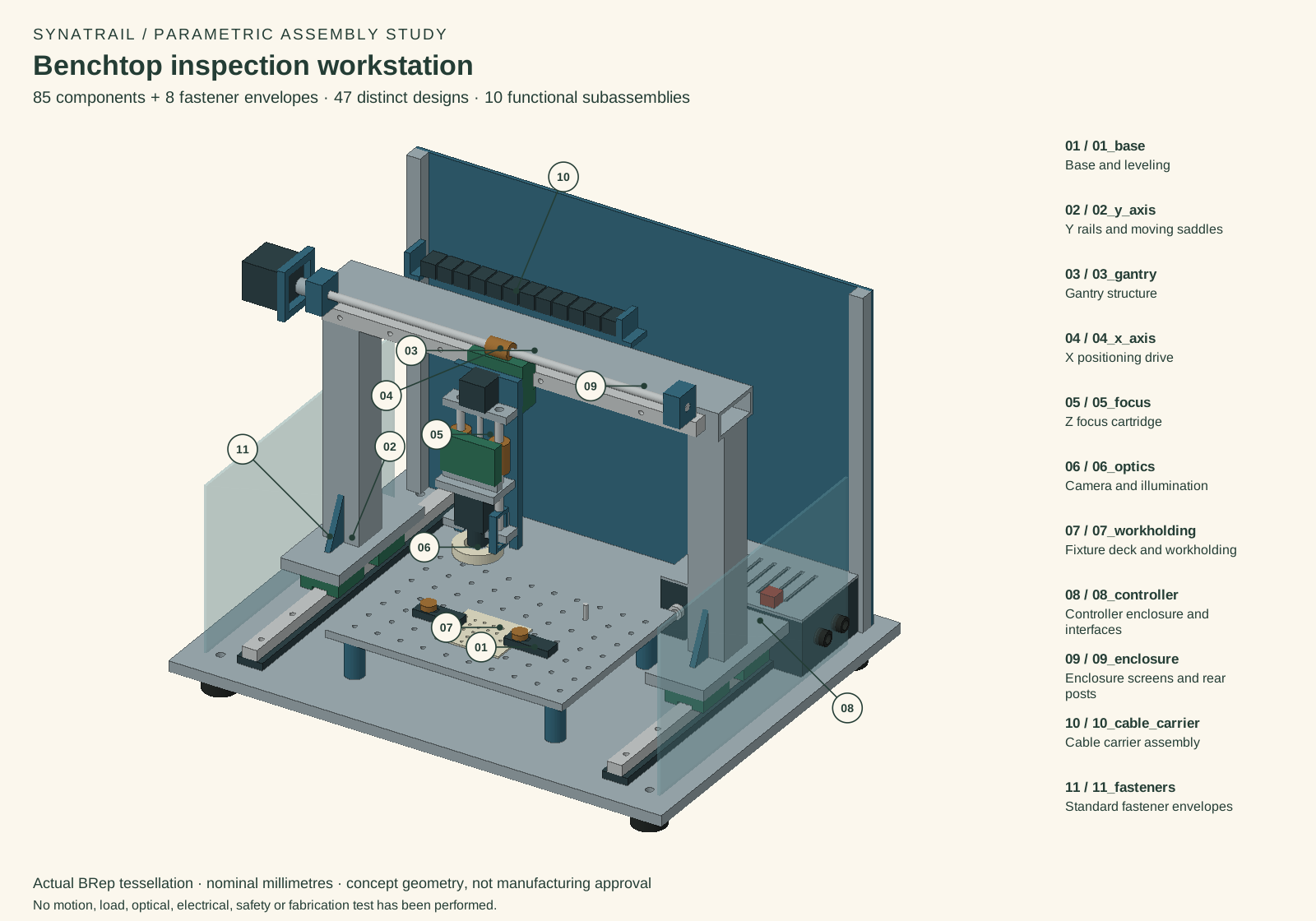
THE ACTUAL ASSEMBLY

Explore the geometry.

Assembled inspection workstation with the gantry, camera, workholding deck, rear panel and controller housing visible.

The drawing and CAD downloads are available below.

THE COMPLEX EXPLODED CAD DRAWINGPRODUCED ARTIFACT
Exploded CAD drawing of a benchtop XYZ inspection station, separating its gantry, motion guides, optics, workholding, enclosure and controller housing.
↳Open the full-size drawing to follow the part callouts and subassembly relationships. This drawing is derived from the same geometry as the downloadable STEP assembly.
DIMENSIONS AND ENGINEERING VIEWSPRODUCED ARTIFACT
Engineering drawing of the inspection station with front, top, side and isometric views and overall dimensions.
↳Use the engineering views with the bill of materials and editable parameters to inspect the proposed interfaces. All dimensions are nominal concept dimensions.

Measure the parts.
Inspect the design.

These orthographic sheets project the saved CAD solids and label nominal millimetres. The base plate, open gantry bridge, controller shell and vented lid share part IDs with the full assembly. Material, tolerance, loads and manufacturing still need engineering review.
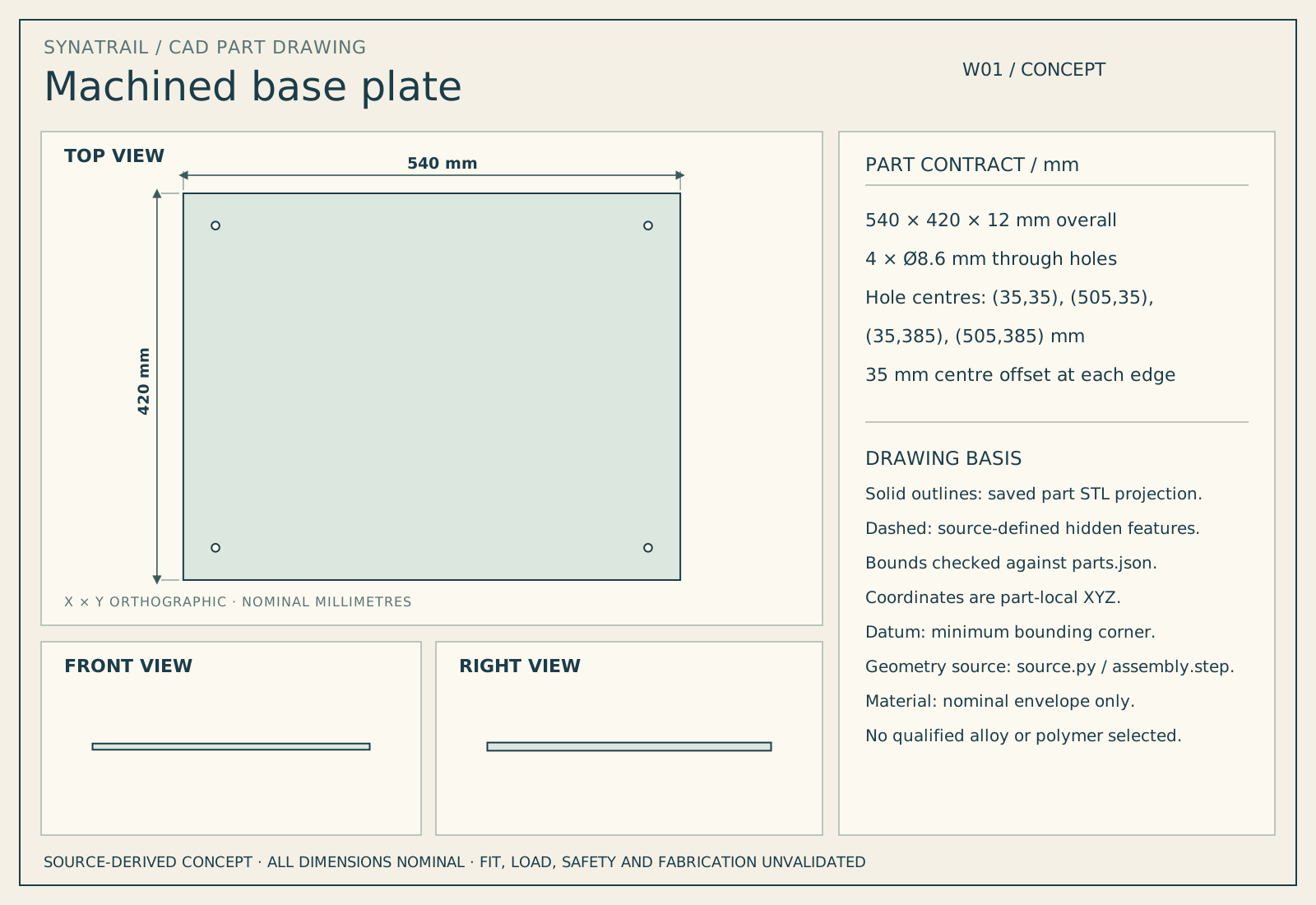
The individual STL files are meshes; the named STEP assembly and Python source contain the editable solid design. The source checks confirm dimensions and geometry bounds, not physical fit or fabrication readiness.

Trace the signals.
Inspect the board.

The workstation study now includes a separate 5 V status indicator concept. Its two dry-contact inputs show whether contact A or B is closed; a third LED shows power. It does not drive motors, control the camera or make inspection decisions. Electrical mounting, wiring, environmental protection and physical behavior still need review.
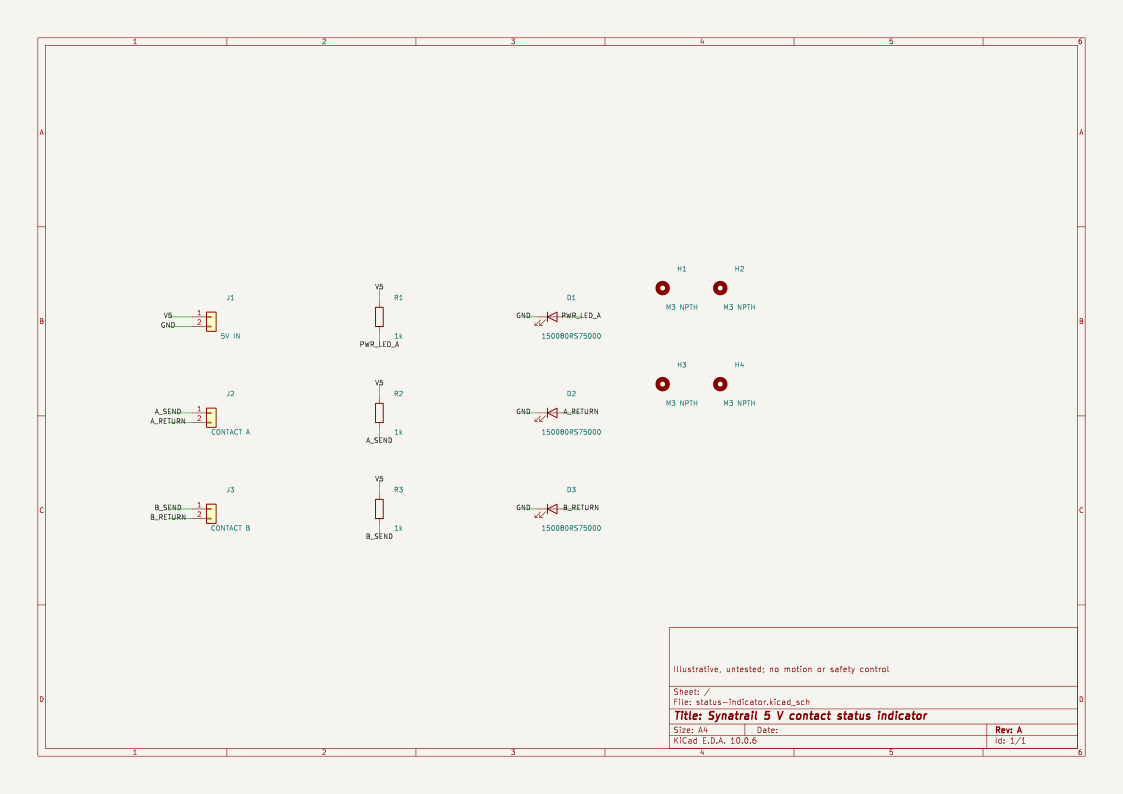
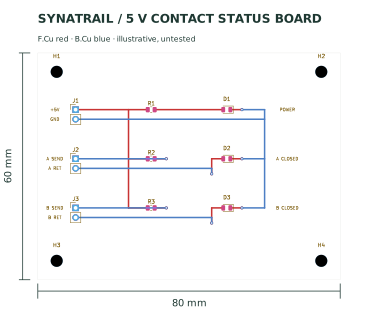
80 × 60 mmBoard outline
4 × Ø3.2 mmMounting holes on a 70 × 50 mm pattern
1.6 mmNominal board thickness
EDITABLE KICAD SCHEMATIC5 V / TWO DRY CONTACTS
Electrical schematic for a five-volt status indicator with power input, two voltage-free contact inputs, three LEDs and one-kilohm current-limiting resistors.
↳The signal paths and connector names come from the editable schematic. Read the pinout before connecting any external circuit.
PCB OUTLINE AND ROUTING80 × 60 MM · CONCEPT
Dimensioned 80 by 60 millimetre status indicator board with connector positions, three LED circuits, red front copper, blue back copper and four mounting holes.
↳This overview combines both copper layers and the nominal board dimensions; the editable layout and fabrication outputs are available below.
FRONT / COMPONENTS
Front of the 80 by 60 millimetre status board with connectors, three LEDs, resistor footprints and mounting holes.
Component placement and board outline.
BACK / COPPER
Back copper view of the status indicator PCB and its four mounting holes.
Back-layer routing and clearances.
ROUTING / BOTH LAYERS
Combined PCB routing view with front and back copper, silk and board outline.
Combined routing for review.

The KiCad exports are inspectable design files, not approval to manufacture or connect this board to the workstation. The controller housing is a nominal CAD envelope; a board mounting interface and electrical integration have not been validated. Compare the controller part drawings ↑

WHAT THESE FILES ESTABLISH

The mechanical package contains compiled solid geometry, part identities, drawings and recorded geometry checks. The separate electrical files describe a status-only board concept. The CAD source was authored from the dimensional contract reviewed by the model team. It is a concept assembly; purchased components are nominal envelopes, and powered operation, optics, loads and manufacturing have not been validated.

A design issue you can inspect: the focus screw intersects the camera housing in the supplied layout. The locked positions are preserved, and the measured interference is recorded in the CAD notes for the next design iteration.
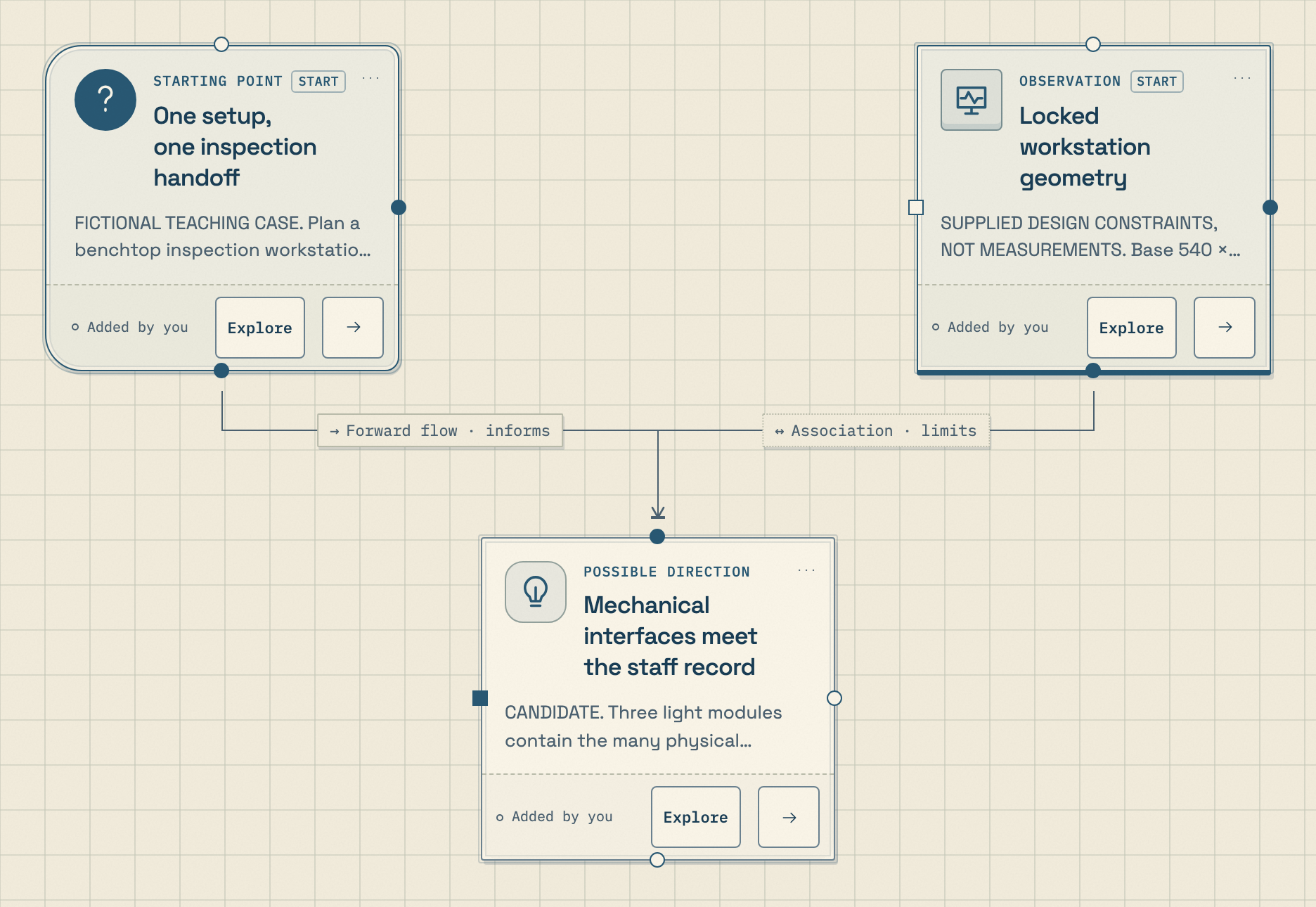
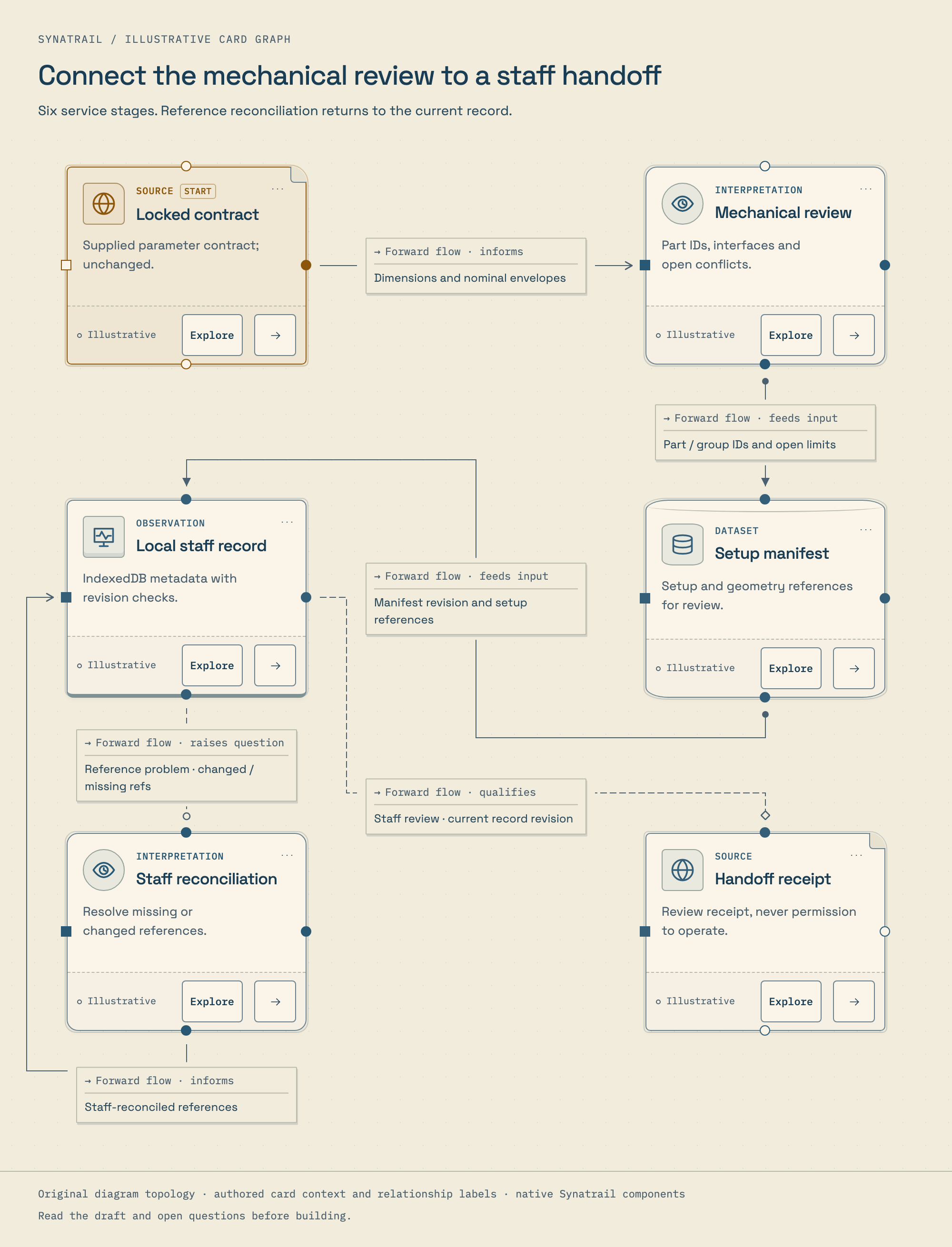
THE THREE-NODE MIXED-PRODUCT CANVASNATIVE Synatrail CARDS
The real Synatrail canvas showing the workstation question, locked geometry and mechanical-to-service concept.
↳Many physical parts, still three investigation cards. The saved light package below contains the resulting product specification.
INSPECTION RECORD AND STAFF HANDOFFNATIVE Synatrail CARDS
Generated process flow connecting workstation setup, a local inspection record and staff-controlled handoff.
↳The service flow connects the physical setup to the proposed local browser record. It describes a planned workflow; no live service has been deployed.
3 nodesA question, supplied context and a candidate solution
3 modules · 6 storiesA light planning package with acceptance criteria
4 model callsPlans, worker outputs and final synthesis recorded
PACKAGE.md

Product specification

Download this document

The resulting light specification: scope, requirements, architecture, risks and the decisions still needing evidence.

Benchtop XYZ inspection workstation — LIGHT

One unchanged mechanical contract, one proposed setup manifest and one staff-controlled local inspection handoff.

Kind: hybrid · Investigation: Benchtop XYZ inspection workstation · Composed: 2026-10-01T21:19:57.622Z · Model details: see the original download

1. Problem space

Who: Setup operators, staff reviewers and receiving service staff in a fictional teaching case.

Pain: Mechanical setup declarations, inspection records and handoffs can disagree or become stale.

Context: Planning only. Supplied dimensions are constraints, not measurements. CAD construction, software implementation and validation are separate later operations.

Evidence: workstation-question One setup, one inspection handoff; workstation-dimensions Locked workstation geometry; workstation-concept Mechanical interfaces meet the staff record

2. Solution idea

Preserve the complete supplied mechanicalDesign and organize its interfaces into two mechanical modules and one local record module. A shared identifier manifest links staff declarations to the unchanged contract without asserting physical verification.

Differentiators

  • Exactly three existing investigation nodes, all revision 1, human-origin and unassessed.
  • One proposed part/subassembly crosswalk shared by mechanical review and staff records.
  • Reference and revision checks block record transitions only; they never command physical action.
  • Engineering limitations remain visible even when record references agree.

Non-goals

  • CAD/source generation or measured geometry validation in this draft.
  • Powered operation, instrument integration, motor control or machine protection implementation.
  • Optical, structural, thermal, electrical, manufacturing or safety approval.
  • Real images, names, customer information, cloud storage, external uploads or authentication claims.
  • Adding parts merely to reach complexity targets.

3. Concept

User journey

  1. Mechanical reviewer catalogs the supplied contract and unresolved interfaces under the shared identifiers.
  2. Setup operator selects M-SETUP-r1 and declares a synthetic setup using FX-DECK-GRID-r1.
  3. Operator completes explicit record checks; the proposed application compares references and the latest local revision.
  4. Reference problems require staff reconciliation; matching references permit record-only confirmation.
  5. Operator offers a handoff containing the declared setup and engineering limitations; receiving service staff acknowledges receipt.
  6. A declared adjustment, fixture change or changed manifest invalidates the prior current confirmation and requires renewed review.

Success criteria

  • The locked mechanicalDesign is preserved field-for-field, including array order and limitations.
  • Three modules contain exactly six stories; no investigation nodes are added.
  • Every referenced part, setup and image has a defined source or an explicit pending status.
  • Proposed synthetic transition cases distinguish record confirmation from physical verification.
  • Future complexity targets remain unachieved until separately evidenced; counts alone establish neither usefulness nor manufacturing readiness.

4. Data

Entities

Entity Fields Source
ContractReference contractRef: C-LOCKED-1, schema: tce-cookbook-mechanical-design-v1, product: inspection-workstation, sourceNode: workstation-dimensions, sourceContentRevision: 1, payload: unchanged supplied mechanicalDesign workstation-dimensions; C-LOCKED-1 is a proposed local snapshot identity, not a new geometry revision.
MechanicalCrosswalk SA01 base/feet: P01 base, P23 foot, SA02 Y guidance/carriages: P02 rail, P03 carriage, P04 saddle, SA03 gantry: P05 tower, P06 bridge, SA04 X guidance/carriage/screw: P07 rail, P08 carriage, P09 screw, SA05 Z guidance/screw: P10 backplate, P11 rod, P12 screw, SA06 optics envelopes: P13 camera body, P14 lens, P15 ring light, SA07 deck/workholding: P16 deck, P17 standoff; fixture hardware undefined, SA08 enclosure: P18 rear panel, P19 side panel, SA09 controller housing: P20 housing, P21 lid, SA10 cable carrier: P22 link Proposed worker-a crosswalk integrated against workstation-dimensions; owned by the mechanical reviewer.
SetupManifest manifestRef: M-SETUP-r1; manifestRevision: 1, contractRef: C-LOCKED-1; sourceContentRevision: 1, partRefs: P01–P23; subassemblyRefs: SA01–SA10, fixtureRef: FX-DECK-GRID-r1, a reference to P16 grid only, setupRef: synthetic identifier, declaredState: manual X, gantry Y and focus Z descriptions, engineeringFlags: endpoints, mounts, optics, access, carrier, loads, electrical Proposed integration of workstation-dimensions and workstation-concept; not physical setup evidence.
InspectionRecord inspectionId: synthetic identifier, setupRef; fixtureRef; contractRef; sourceContentRevision, manifestRef; manifestRevision, recordRevision: increasing integer, checks: code, outcome, responsibleRole, discrepancies: controlled synthetic codes, imageRefs: optional synthetic reference IDs, inspectionState: draft | ready | confirmed | review-required, handoffStatus: none | offered | acknowledged, declaredState; engineeringFlags; receivingRoleAcknowledgement workstation-concept; proposed staff module schema with no names or customer fields.
ImageReference imageId: IMG-ASM | IMG-EXP | IMG-SEC, owner: future separate geometry builder, status: pending | available-synthetic, sourceRef: absent until a synthetic source is registered, contractRef; manifestRef; manifestRevision Proposed future references from worker-a; no images or CAD outputs currently exist.

Evidence used as data

Evidence Use
workstation-question One setup, one inspection handoff Revision 1; fictional scope, staff ownership and exclusion of energized operation.
workstation-dimensions Locked workstation geometry Revision 1; supplied constraints and unchanged separate mechanicalDesign contract.
workstation-concept Mechanical interfaces meet the staff record Revision 1; candidate manifest, local record and human handoff workflow.

5. Architecture

Proposed architecture: a read-only contract and mechanical crosswalk feed a versioned setup manifest. A local browser record compares selected references with the latest IndexedDB record inside a transaction before a staff-requested transition. There is no connection to machinery. Geometry below summarizes selected supplied parts only; mechanicalDesign remains authoritative. Materials, masses and unspecified envelopes are intentionally not invented.

Components

Component Responsibility Technology
Contract and interface register Preserve the supplied JSON, own P01–P23 and SA01–SA10, and list unresolved mechanical interfaces. Read-only JSON and Markdown review documents
Setup manifest Bind contract, fixture/grid reference, declared setup and engineering flags under M-SETUP-r1. Versioned local JSON
Staff record demonstration Present role-controlled checks, revision comparison, record states and handoff receipt. Proposed TypeScript and semantic HTML; not implemented
Local persistence and export Store synthetic metadata and explicitly export a point-in-time JSON copy. Proposed IndexedDB transactions and browser Blob download

Interfaces

From To Protocol Purpose
Contract and interface register Setup manifest Local JSON references Reuse the unchanged contract identity and shared part/subassembly IDs; retain unresolved engineering flags.
Setup manifest Staff record demonstration Local read-only manifest selection Compare contract, manifest, setup and fixture references before a staff-requested confirmation.
Staff record demonstration Local persistence and export IndexedDB readwrite transaction; explicit JSON download Reject stale record revisions and persist accepted record changes; export a separate, potentially stale copy.

Deployment: Future local-only browser demonstration in one browser/profile. This package deploys nothing. Browser clearing can erase records; downloaded exports are not authoritative live records.

6. Modules

Id Module Purpose Depends on
m1 Base and motion structure Review SA01–SA05: base/feet, Y guidance, gantry, X guidance/screw and Z focus guidance/screw. —
m2 Workholding/optics/enclosure interfaces Review SA06–SA10: optics, deck/workholding, enclosure, controller housing and cable carrier. m1
m3 Local staff inspection record and service handoff Specify synthetic local metadata, reference checks, explicit staff transitions and receiving-role acknowledgement. m1, m2

7. Build waves

Wave 1 · Wave 1 — Mechanical reference baseline (sequential)

Review M1 then M2, publish the shared manifest and preserve all unresolved mechanical questions without CAD generation.

Modules: m1, m2

Wave 2 · Wave 2 — Record and handoff specification (sequential)

Specify M3 against the reviewed reference baseline and prepare proposed synthetic checks, without implementation.

Modules: m3

8. PRDs

m1

M1-S1 · Review assembly interfaces against the locked contract

  • Register SA01–SA05 using P01–P12 and P23; retain unknown quantities and attachment definitions.
  • Distinguish supplied coordinates, analytic interface questions and future measured evidence; preserve the full contract.

M1-S2 · Review declared manual positioning and clearance questions

  • List missing Y endpoints, X 300 mm and Z 30 mm endpoint definitions, moving/fixed assignments and motion-protection questions.
  • Request later endpoint and section checks; do not authorize movement or claim a usable stroke.
m2

M2-S1 · Review fixture/grid and optics references

  • Define FX-DECK-GRID-r1 solely as P16's supplied grid reference, not a workholding device.
  • Record conditional camera/backplate and ring/backplate intersections and unresolved optics attachment; change no dimensions.

M2-S2 · Review enclosure, cable and service interfaces

  • Identify P18–P23, eight vent features and twelve carrier links without counting vents as parts.
  • Register unknown panel placement, lid access, carrier route, cable clearances, mounting and electrical integration for later review.
m3

M3-S1 · Specify staff setup-reference confirmation

  • Use synthetic records and the shared crosswalk; compare selected references and the latest stored record revision.
  • Stale views, missing listed references and mismatches block record confirmation only; staff reconcile and repeat checks.

M3-S2 · Specify staff handoff and receipt

  • Offer the declared setup, current record revision, limitations and optional resolved synthetic image references to receiving service staff.
  • Require explicit receiving-role acknowledgement; changed setup or references revoke current confirmation and require renewed review.

9. Bill of materials

Part Qty Specification Est. cost Supplier hint
P01 base 1 540 × 420 × 12 mm; material and mass unspecified. Not estimated Not selected
P02 Y rail 2 360 × 16 × 12 mm nominal envelope; not vendor-qualified. Not estimated Not selected
P06 bridge 1 440 × 60 × 30 mm; wall 4 mm. Not estimated Not selected
P07 X rail 1 410 × 16 × 16 mm nominal envelope. Not estimated Not selected
P08 X carriage 1 60 × 24 × 50 mm nominal envelope. Not estimated Not selected
P09 X screw 1 Diameter 8 mm; length and drive connection unspecified. Not estimated Not selected
P10 focus backplate 1 70 × 8 × 180 mm; attachment and relief unresolved. Not estimated Not selected
P11 focus rod 2 Diameter 8 mm; length 120 mm. Not estimated Not selected
P12 focus screw 1 Diameter 6 mm; length and nut interface unspecified. Not estimated Not selected
P13 camera-body envelope 1 32 × 32 × 40 mm; nominal geometry only. Not estimated Not selected
P14 lens envelope 1 Diameter 20 mm; length 22 mm; placement interface unresolved. Not estimated Not selected
P15 ring-light envelope 1 OD 48 mm; ID 26 mm; thickness 10 mm. Not estimated Not selected
P16 deck 1 260 × 200 × 8 mm; grid pitch 25 mm; hole diameter 5 mm. Not estimated Not selected
P17 standoff 4 Diameter 20 mm; height 44 mm; attachment unspecified. Not estimated Not selected
P18 rear panel 1 500 × 4 × 360 mm. Not estimated Not selected
P20 controller housing 1 Outer size 155 × 100 × 58 mm; wall 3 mm; eight vent features, not separate parts. Not estimated Not selected
P21 controller lid 1 Thickness 3 mm; footprint, attachment and fit unresolved. Not estimated Not selected
P22 carrier link 12 Pitch 18 mm; width 22 mm; height 16 mm; full link envelope and joints unspecified. Not estimated Not selected
P23 foot 4 Diameter 36 mm; height 24 mm; Z placement and mounting unresolved. Not estimated Not selected

10. Geometry

Each part below gets parametric source, STEP/STL exports and dimensioned drawings in cad/<part>/ once its geometry is generated; the runner checks the measured envelope and mass against these values.

Id Part Kind Envelope (mm) Material Mass (g) Tool Module BOM part
p01 Base mechanical 540 × 420 × 12 Unspecified; mass unknown auto m1 P01 base
p02 Y rail envelope mechanical 16 × 360 × 12 Unspecified; mass unknown auto m1 P02 Y rail
p06 Gantry bridge mechanical 440 × 60 × 30 Unspecified; mass unknown auto m1 P06 bridge
p08 X carriage envelope mechanical 60 × 24 × 50 Unspecified; mass unknown auto m1 P08 X carriage
p10 Focus backplate mechanical 70 × 8 × 180 Unspecified; mass unknown auto m1 P10 focus backplate
p13 Camera-body envelope electronic 32 × 32 × 40 Unspecified; mass unknown auto m2 P13 camera-body envelope
p16 Perforated work deck mechanical 260 × 200 × 8 Unspecified; mass unknown auto m2 P16 deck
p18 Rear enclosure panel mechanical 500 × 4 × 360 Unspecified; mass unknown auto m2 P18 rear panel
p20 Controller housing mechanical 155 × 100 × 58 Unspecified; mass unknown auto m2 P20 controller housing

Design system

  • Show contract and manifest references beside every declared setup.
  • Separate reference blockers from acknowledged engineering limitations.
  • Use text labels as well as color for every state.
  • Label confirmation as record-only and acknowledgement as receipt-only.

Tone: Plain, cautious and specific; never present a record state as permission to operate. · Colors: #172033 text, #FFFFFF background, #92400E review warning, #B91C1C reference blocker, #1D4ED8 record action · Typography: System sans-serif for prose; monospace for IDs and revisions.

Agent concurrency

Up to 1 builder(s) in parallel.

Shared files (serialize edits)

  • mechanicalDesign.json
  • mechanical-crosswalk.json
  • setup-manifest.json
  • record-contract.md
  • review-register.md

Rules

  • One builder works sequentially through M1, M2 and M3.
  • These are proposed artifact names; no files are claimed to exist.
  • Never edit the supplied mechanicalDesign payload.
  • Only the mechanical-review role changes the proposed crosswalk; dependent manifest changes require record review.
  • Stop at review specifications and proposed checks; CAD, source generation and measured validation are later operations.
  • Use only the three supplied investigation nodes.

Controls and tests

Area Check Method
Contract preservation Proposed check: all values, array order, units, origin and limitations match the supplied JSON. Later recursive JSON comparison against the supplied payload; report every difference.
Mechanical interfaces Proposed check: document conditional optics overlaps, X attachment questions and undefined motion endpoints. Review supplied-coordinate arithmetic now; request later identified sections and endpoint checks.
Geometry evidence Future targets: 60–100 placed components, at least 25 distinct non-fastener designs and at least 8 subassemblies. Separate builder reports actual counts, bounds, assembly, exploded and section views; no result asserted.
Reference confirmation Proposed cases: matching references, changed fixture, changed manifest, stale view and missing listed image. Specify synthetic inputs and expected record-only outcomes; do not report execution or passing results.
Revision integrity Proposed case: two views request transitions from the same record revision; the stale request is rejected. Later exercise transactional latest-revision comparison with two synthetic browser views.
Handoff and adjustment Proposed cases: incomplete offer, unacknowledged limitations and a setup change after acknowledgement. Walk the role/state table; expect blocked receipt or renewed review, never physical action.
Local-only scope Proposed review: metadata only, no network uploads, device APIs, real images or identity claims. Review future schema, browser API use and export fields against the exclusions.
Prototype evidence boundary Loads, fits, protection, electrical integration and prototype validation remain unresolved. Maintain an open review register; do not substitute counts, renderings or record states for validation.

Dependencies

Dependency Kind Reason
Supplied mechanicalDesign and workstation-dimensions revision 1 data Authoritative locked geometry input, not measurement evidence.
workstation-question and workstation-concept revision 1 data Define synthetic scope, staff ownership and candidate local workflow.
IndexedDB standard Proposed browser-local transactional metadata storage; no implementation supplied.
TypeScript library Proposed language/toolchain for a later bounded browser demonstration.
JSON standard Shared manifest and explicit local export format.

Risks

Risk Mitigation
Conditional camera-body and ring-light intersections with the unrelieved backplate. Preserve geometry and flag conditional envelope conflicts; request explicit mounting interpretation and later sections.
Undefined engagement, drive connections, endpoints and attachment faces undermine motion conclusions. Do not infer usable travel from rail lengths or nominal travel; require separately reviewed definitions.
A confirmed record or acknowledged handoff is mistaken for physical approval. Use record-only labels and retain engineering limitations in the record and handoff.
Local persistence is cleared, or a downloaded copy is mistaken for the latest record. Explain browser/profile limits, include revisions in exports and provide no import or cloud-sync path in this scope.
Complexity targets encourage unsupported parts or inflated design counts. Count only later evidenced geometry; do not treat identifiers, vent features or repeated instances as distinct designs.
The controller, panels and carrier appear integrated despite undefined wiring, access and protection. Keep electrical integration, loads, routing, guarding and prototype validation explicitly unresolved.

Open questions

  • What are the Y carriage, saddle, tower and side-panel quantities and placements? P03–P05 and P19 remain outside the quantified BOM.
  • What defines Y, X and Z endpoints, moving/fixed assignments, screw lengths and drive connections?
  • How do the X rail/carriage and focus backplate/carriage attach without altering locked coordinates?
  • What mounting interpretation resolves the conditional camera/backplate and ring/backplate intersections?
  • What workholding hardware, deck-hole origins, attachment details, materials, tolerances and masses are intended?
  • What loads, stiffness, stability, motion protection and manual-adjustment provisions require later engineering review?
  • How are the controller lid, feet, side panels and carrier endpoints mounted, and what service clearances are needed?
  • What electrical interfaces, wiring, cable bend limits and component selections would a later unenergized integration review require?

Evidence

  • workstation-question One setup, one inspection handoff
  • workstation-dimensions Locked workstation geometry
  • workstation-concept Mechanical interfaces meet the staff record

Recorded investigation basis

Frozen scope: my canvas revision 1

No linked decision is inferred; review the retained records before treating this draft as a commitment.

Selected concept

No selected named concept was present in the frozen package scope.

Human decision records

No selected human concept decision record.

Exact selected material
  • workstation-question One setup, one inspection handoff (content 1)
  • workstation-dimensions Locked workstation geometry (content 1)
  • workstation-concept Mechanical interfaces meet the staff record (content 1)

Frozen specification

Export state: Needs review · Specification revision: 1

Specification digest: 5ecf6b810ad05d603a2d2f98308022779915a9b0f497c13ddfe7b3b8b50293ff

No human approval for handoff is recorded for this exact specification revision. Downloading or copying this export does not approve it.

R1 · revision 1 · Needs review

Preserve the supplied mechanical contract and the bounded investigation scope.

Acceptance

  • Return the complete supplied mechanicalDesign unchanged, including schema, product, coordinate system, all parameters, array order and all three limitations. Its values are supplied proposed constraints, not measurements or compiled CAD. Dimensional summaries never override it.
  • Use exactly workstation-question, workstation-dimensions and workstation-concept, each at contentRevision 1. Retain their human-origin, unassessed status; add no investigation nodes or evidence sources.
  • Keep exactly M1, M2 and M3, two stories each, two sequential waves and one builder. This draft generates no CAD, application source, physical-test results or deployed system.

Decision records

No exact human decision record.

Evidence versions

  • canvas=my, nodeId=workstation-question, contentRevision=1
  • canvas=my, nodeId=workstation-dimensions, contentRevision=1
  • canvas=my, nodeId=workstation-concept, contentRevision=1

Assumptions

  • The supplied contract is the intended input for the separate deterministic builder.

Unresolved

  • No CAD compilation, geometry measurements or prototype validation exist in this review.
R2 · revision 1 · Needs review

Use one proposed mechanical crosswalk and an honest partial BOM.

Acceptance

  • Adopt P01–P23 and SA01–SA10 exactly as listed in MechanicalCrosswalk. Mechanical reviewer owns identifiers; M3 reuses them. C-LOCKED-1 identifies the unchanged supplied payload, and M-SETUP-r1 is a proposed manifest revision, not a revised mechanical contract.
  • Quantify only explicitly supported counts or singular named elements. P03–P05 and P19 quantities remain unknown. Do not add mounts, fasteners, fixtures, motors, bearings or connectors without supplied definitions. Eight vents are features, not parts; twelve links are repeated instances, not twelve distinct designs.
  • FX-DECK-GRID-r1 refers only to P16's grid. It does not establish a physical workholding fixture. Geometry entries are a permitted summary of supplied envelopes, not a complete drawing release. Unspecified materials, masses, lengths, placements and fits remain unknown; omitted massG is not zero.
  • Request later assembly, exploded and section views plus actual counts and bounds. The 60–100 placed-component, at least 25 distinct non-fastener-design and at least 8 functional-subassembly targets are unchecked. More parts do not demonstrate usefulness or manufacturing readiness.

Decision records

No exact human decision record.

Evidence versions

  • canvas=my, nodeId=workstation-dimensions, contentRevision=1

Assumptions

  • Singular named contract elements support the provisional quantities shown.
  • The proposed identifiers are suitable for later builder reconciliation.

Unresolved

  • Unknown quantities, manufacturing partition, complete envelopes, materials, masses and vendor selections.
R3 · revision 1 · Needs review

Record mechanical conflicts without changing geometry or asserting validation.

Acceptance

  • If the camera body is centered on X270/Y110, its nominal Y94–126 and Z190–230 envelope overlaps the unrelieved backplate at Y124–132 and Z164–344. A centered ring reaches Y134 and spans Z158–168, allowing a conditional backplate intersection. These are supplied-coordinate deductions, not measured collisions; placement, relief and attachments remain unresolved.
  • X carriage Y140–164 meets the rail front at Y164 without defining engagement. Backplate Y124–132 and carriage Y140–164 leave an analytic 8 mm separation without an attachment definition. X screw center Z357 is above carriage top Z351 without a drive connection. Do not invent brackets, reliefs or coordinate changes.
  • Treat X 300 mm and Z 30 mm as nominal travel proposals, not demonstrated strokes. Y endpoints, motion sweeps, mounting faces, cable route, service access, foot Z placement and moving/fixed assignments need explicit definitions before later geometry checks.
  • Manual adjustment is an untested workflow assumption, not a movement instruction. Fits, loads, stiffness, stability, motion protection, optical performance, electrical integration and prototype validation remain open. No powered or energized operation, machine-control implementation, safety approval or compliance claim is in scope.

Decision records

No exact human decision record.

Evidence versions

  • canvas=my, nodeId=workstation-dimensions, contentRevision=1

Assumptions

  • The reported optics intersections assume axis-centered, unrelieved nominal solids.
  • Staff may describe a manual setup without the record proving its physical state.

Unresolved

  • All cited attachments, conditional intersections, motion definitions and engineering validation.
R4 · revision 1 · Needs review

Specify minimal local synthetic storage and record-only confirmation gates.

Acceptance

  • Propose TypeScript, semantic HTML and IndexedDB for a later local demonstration. Store only synthetic inspection IDs, reference IDs, declared setup, controlled check/discrepancy codes, revisions, role labels and state. Exclude names, customer data, real images, cloud, external uploads, authentication claims, instrument links and machine control.
  • Before any confirmation or handoff transition, compare the selected manifest, contract, setup and fixture references with the current local manifest selection and latest stored record revision. A proposed IndexedDB readwrite transaction checks the expected revision and saves the next revision atomically; stale requests reject without overwriting newer records. Selected manifest changes require review rather than automatic reference substitution.
  • Missing listed references, mismatches, incomplete required checks and unresolved reference discrepancies block confirmation only. Staff reviewer reconciles them; setup operator repeats checks. Known engineering limitations may remain as explicitly acknowledged flags and do not imply physical approval. Matching references cannot verify the workstation.
  • Browser-local data belongs to one browser/profile and may be erased. Explicit JSON export includes schema, contract, manifest and record revisions and is a point-in-time copy, never the live latest record. Import and synchronization are out of scope.

Decision records

No exact human decision record.

Evidence versions

  • canvas=my, nodeId=workstation-concept, contentRevision=1
  • canvas=my, nodeId=workstation-question, contentRevision=1

Assumptions

  • A single browser/profile is sufficient for the teaching demonstration.
  • Role labels express staff responsibility, not authenticated identity.

Unresolved

  • Browser behavior, persistence and race handling require later implementation review and proposed tests.
R5 · revision 1 · Needs review

Define staff-controlled inspection and handoff transitions.

Acceptance

  • Transition table: draft → ready, setup operator, requires defined references and completed checks, rejects missing references or incomplete checks. ready → confirmed, setup operator, requires latest-revision comparison and matching references, rejects stale views, mismatches or unresolved reference discrepancies. confirmed → review-required, setup operator declares adjustment or fixture change; retaining current confirmation is prohibited.
  • review-required → ready: staff reviewer reconciles references and records disposition of discrepancies; setup operator repeats checks. Reject unresolved reference mismatches. Selected-manifest changes likewise require review. Every accepted change increments recordRevision; previous confirmation and receipt are historical, not current.
  • With inspectionState confirmed, handoffStatus none → offered: setup operator supplies the declared setup, current references, record revision, engineering limitations and any resolved image references. Reject an incomplete package. offered → acknowledged: receiving service staff reviews those items and explicitly acknowledges receipt and limitations; reject missing references or unacknowledged limitations.
  • A declared setup, fixture or manifest change after offering or acknowledgement sets inspectionState to review-required and current handoffStatus to none. Staff must reconcile, repeat checks, reconfirm and reoffer. Record blocking, invalidation, export and receipt never trigger movement, shutdown or any other physical action.

Decision records

No exact human decision record.

Evidence versions

  • canvas=my, nodeId=workstation-concept, contentRevision=1
  • canvas=my, nodeId=workstation-question, contentRevision=1

Assumptions

  • Staff declare changes; the demonstration cannot detect physical adjustments.
  • A reviewer and receiving role can acknowledge limitations without approving operation.

Unresolved

  • Human procedure usability and responsibility assignment need later review.
R6 · revision 1 · Needs review

Keep pending image references and proposed checks distinct from evidence.

Acceptance

  • IMG-ASM, IMG-EXP and IMG-SEC are pending catalogue entries owned by the future separate geometry builder, not produced images. Record imageRefs may be empty. A pending catalogue entry does not itself block a record; listing it in that record without an available synthetic source does block confirmation until staff resolve or remove it through a revision.
  • Future synthetic cases cover matching references, changed fixture, changed manifest, stale view, missing listed image, competing record revisions, incomplete handoff and change after acknowledgement. Specify expected record outcomes only; do not claim execution or passing tests.
  • Only the three supplied revision-1 nodes are cited as evidence. Future CAD views, count reports, source outputs and prototype observations are requests, not current evidence. Separate future geometry checks must report their methodology and unresolved definitions rather than silently repairing the locked input.

Decision records

No exact human decision record.

Evidence versions

  • canvas=my, nodeId=workstation-concept, contentRevision=1
  • canvas=my, nodeId=workstation-dimensions, contentRevision=1

Assumptions

  • Optional synthetic image references can be omitted until an identified source exists.

Unresolved

  • All image outputs, geometry reports and check results remain pending.
Exact reference availability
  • canvas=my, nodeId=workstation-question, contentRevision=1 — current
  • canvas=my, nodeId=workstation-dimensions, contentRevision=1 — current
  • canvas=my, nodeId=workstation-concept, contentRevision=1 — current
Honest unresolved context

Contradictions, risks and missing evidence

  • Conditional camera-body and ring-light intersections with the unrelieved backplate. — Preserve geometry and flag conditional envelope conflicts; request explicit mounting interpretation and later sections.
  • Undefined engagement, drive connections, endpoints and attachment faces undermine motion conclusions. — Do not infer usable travel from rail lengths or nominal travel; require separately reviewed definitions.
  • A confirmed record or acknowledged handoff is mistaken for physical approval. — Use record-only labels and retain engineering limitations in the record and handoff.
  • Local persistence is cleared, or a downloaded copy is mistaken for the latest record. — Explain browser/profile limits, include revisions in exports and provide no import or cloud-sync path in this scope.
  • Complexity targets encourage unsupported parts or inflated design counts. — Count only later evidenced geometry; do not treat identifiers, vent features or repeated instances as distinct designs.
  • The controller, panels and carrier appear integrated despite undefined wiring, access and protection. — Keep electrical integration, loads, routing, guarding and prototype validation explicitly unresolved.

Risks accepted for this exact handoff

None. This revision has no handoff approval.

Unanswered questions

  • What are the Y carriage, saddle, tower and side-panel quantities and placements? P03–P05 and P19 remain outside the quantified BOM.
  • What defines Y, X and Z endpoints, moving/fixed assignments, screw lengths and drive connections?
  • How do the X rail/carriage and focus backplate/carriage attach without altering locked coordinates?
  • What mounting interpretation resolves the conditional camera/backplate and ring/backplate intersections?
  • What workholding hardware, deck-hole origins, attachment details, materials, tolerances and masses are intended?
  • What loads, stiffness, stability, motion protection and manual-adjustment provisions require later engineering review?
  • How are the controller lid, feet, side panels and carrier endpoints mounted, and what service clearances are needed?
  • What electrical interfaces, wiring, cable bend limits and component selections would a later unenergized integration review require?
  • No CAD compilation, geometry measurements or prototype validation exist in this review.
  • Unknown quantities, manufacturing partition, complete envelopes, materials, masses and vendor selections.
  • All cited attachments, conditional intersections, motion definitions and engineering validation.
  • Browser behavior, persistence and race handling require later implementation review and proposed tests.
  • Human procedure usability and responsibility assignment need later review.
  • All image outputs, geometry reports and check results remain pending.

Assumptions

  • The supplied contract is the intended input for the separate deterministic builder.
  • Singular named contract elements support the provisional quantities shown.
  • The proposed identifiers are suitable for later builder reconciliation.
  • The reported optics intersections assume axis-centered, unrelieved nominal solids.
  • Staff may describe a manual setup without the record proving its physical state.
  • A single browser/profile is sufficient for the teaching demonstration.
  • Role labels express staff responsibility, not authenticated identity.
  • Staff declare changes; the demonstration cannot detect physical adjustments.
  • A reviewer and receiving role can acknowledge limitations without approving operation.
  • Optional synthetic image references can be omitted until an identified source exists.

Requirements without an exact decision record

  • R1
  • R2
  • R3
  • R4
  • R5
  • R6

Pending claims / requirements awaiting human review

  • R1
  • R2
  • R3
  • R4
  • R5
  • R6

Some retained historical material is unavailable. Its frozen identifiers remain visible, but this export does not restore or disclose the unavailable private content.

prd/m1.md

Module requirements

Download this document

The generated implementation stories and their observable acceptance criteria.

PRD · Base and motion structure

Review SA01–SA05: base/feet, Y guidance, gantry, X guidance/screw and Z focus guidance/screw.

M1-S1 · Review assembly interfaces against the locked contract

Acceptance:

  • Register SA01–SA05 using P01–P12 and P23; retain unknown quantities and attachment definitions.
  • Distinguish supplied coordinates, analytic interface questions and future measured evidence; preserve the full contract.

M1-S2 · Review declared manual positioning and clearance questions

Acceptance:

  • List missing Y endpoints, X 300 mm and Z 30 mm endpoint definitions, moving/fixed assignments and motion-protection questions.
  • Request later endpoint and section checks; do not authorize movement or claim a usable stroke.
prd/m2.md

Module requirements

Download this document

The generated implementation stories and their observable acceptance criteria.

PRD · Workholding/optics/enclosure interfaces

Review SA06–SA10: optics, deck/workholding, enclosure, controller housing and cable carrier. Depends on: m1

M2-S1 · Review fixture/grid and optics references

Acceptance:

  • Define FX-DECK-GRID-r1 solely as P16's supplied grid reference, not a workholding device.
  • Record conditional camera/backplate and ring/backplate intersections and unresolved optics attachment; change no dimensions.

M2-S2 · Review enclosure, cable and service interfaces

Acceptance:

  • Identify P18–P23, eight vent features and twelve carrier links without counting vents as parts.
  • Register unknown panel placement, lid access, carrier route, cable clearances, mounting and electrical integration for later review.
prd/m3.md

Module requirements

Download this document

The generated implementation stories and their observable acceptance criteria.

PRD · Local staff inspection record and service handoff

Specify synthetic local metadata, reference checks, explicit staff transitions and receiving-role acknowledgement. Depends on: m1, m2

M3-S1 · Specify staff setup-reference confirmation

Acceptance:

  • Use synthetic records and the shared crosswalk; compare selected references and the latest stored record revision.
  • Stale views, missing listed references and mismatches block record confirmation only; staff reconcile and repeat checks.

M3-S2 · Specify staff handoff and receipt

Acceptance:

  • Offer the declared setup, current record revision, limitations and optional resolved synthetic image references to receiving service staff.
  • Require explicit receiving-role acknowledgement; changed setup or references revoke current confirmation and require renewed review.
AGENTS.md

Instructions for the builder

Download this document

The order of work, concurrency rules and checks exported with this package.

AGENTS.md

You are building Benchtop XYZ inspection workstation — LIGHT (hybrid). Read PACKAGE.md first; it is the complete product definition. Do not widen the scope beyond it.

Frozen specification revision 1 · Needs review. Downloading this archive did not approve it. Resolve every item marked unresolved or awaiting review instead of treating it as verified.

Order of work

  1. Wave 1 — Mechanical reference baseline (sequential): prd/m1.md, prd/m2.md — Review M1 then M2, publish the shared manifest and preserve all unresolved mechanical questions without CAD generation.
  2. Wave 2 — Record and handoff specification (sequential): prd/m3.md — Specify M3 against the reviewed reference baseline and prepare proposed synthetic checks, without implementation.

Concurrency

At most 1 builder(s) at once. Serialize edits to: mechanicalDesign.json, mechanical-crosswalk.json, setup-manifest.json, record-contract.md, review-register.md.

  • One builder works sequentially through M1, M2 and M3.
  • These are proposed artifact names; no files are claimed to exist.
  • Never edit the supplied mechanicalDesign payload.
  • Only the mechanical-review role changes the proposed crosswalk; dependent manifest changes require record review.
  • Stop at review specifications and proposed checks; CAD, source generation and measured validation are later operations.
  • Use only the three supplied investigation nodes.

Definition of done

  • Contract preservation: Proposed check: all values, array order, units, origin and limitations match the supplied JSON. (Later recursive JSON comparison against the supplied payload; report every difference.)
  • Mechanical interfaces: Proposed check: document conditional optics overlaps, X attachment questions and undefined motion endpoints. (Review supplied-coordinate arithmetic now; request later identified sections and endpoint checks.)
  • Geometry evidence: Future targets: 60–100 placed components, at least 25 distinct non-fastener designs and at least 8 subassemblies. (Separate builder reports actual counts, bounds, assembly, exploded and section views; no result asserted.)
  • Reference confirmation: Proposed cases: matching references, changed fixture, changed manifest, stale view and missing listed image. (Specify synthetic inputs and expected record-only outcomes; do not report execution or passing results.)
  • Revision integrity: Proposed case: two views request transitions from the same record revision; the stale request is rejected. (Later exercise transactional latest-revision comparison with two synthetic browser views.)
  • Handoff and adjustment: Proposed cases: incomplete offer, unacknowledged limitations and a setup change after acknowledgement. (Walk the role/state table; expect blocked receipt or renewed review, never physical action.)
  • Local-only scope: Proposed review: metadata only, no network uploads, device APIs, real images or identity claims. (Review future schema, browser API use and export fields against the exclusions.)
  • Prototype evidence boundary: Loads, fits, protection, electrical integration and prototype validation remain unresolved. (Maintain an open review register; do not substitute counts, renderings or record states for validation.)

CAD

If generated artifacts are present, cad/<part>/ holds their parametric source and exported views. The dimensions and mass in PACKAGE.md are design requirements, not measurements or proof of manufacture. Inspect each generated result and its checks before use.

Every story in prd/ must meet its acceptance criteria before the wave is complete. Ask a human when an open question in PACKAGE.md blocks a decision; do not guess.

findings.md

Investigation findings

Download this document

Read the worker findings and the reasoning behind the proposed product.

Benchtop XYZ inspection workstation

Actual worker outputs; supplied dimensions are design constraints, not measurements.

Mechanical integration, clearances and BOM interfaces — worker-a; bounded to workstation-dimensions and the mechanical contribution to workstation-question · focused review

  • Investigation references are exactly workstation-question, workstation-dimensions and workstation-concept, each at contentRevision 1. Their supplied origins are human and their evidence statuses are unassessed. The mechanical contract is supplied design data, not measured geometry; workstation-concept is a candidate interface idea.
  • Coordinate basis: mm; X width, Y depth, Z up; origin at the base lower-front-left. The base occupies nominal X0–540, Y0–420, Z0–12. The deck minimum [140,50,56] and size [260,200,8] put its nominal underside at Z56. A standoff of supplied height 44 would span the difference from the base top at Z12, but its mounting and deck attachment are unspecified.
  • The Y rail centres are X70 and X470, with rails running Y30–390. The bridge minimum [50,180,310] and size [440,60,30] place its nominal X extent across both rail centres and its Y midpoint at the supplied gantry centre Y210. Rail-to-carriage, carriage-to-saddle, saddle-to-tower and tower-to-bridge attachments remain undefined; carriage spacing does not define motion endpoints.
  • The X rail runs nominally X65–475 at front Y164 and minimum Z318. Its proposed travel is 300 mm, not a defined endpoint pair or demonstrated stroke. The X carriage, X screw and focus backplate need specified attachment faces and moving-versus-fixed assignments. The Z rods have supplied length 120 mm; the proposed 30 mm focus travel likewise has no endpoint definition.
  • Functional subassemblies, not additional LIGHT modules: SA01 base/feet; SA02 Y guidance/carriages; SA03 gantry; SA04 X guidance/carriage/screw; SA05 Z guidance/screw; SA06 optics envelopes; SA07 deck/workholding; SA08 enclosure; SA09 controller housing; SA10 cable carrier. Proposed stable part-ID crosswalk: P01 base; P02 Y rail; P03 Y carriage; P04 Y saddle; P05 gantry tower; P06 bridge; P07 X rail; P08 X carriage; P09 X screw; P10 focus backplate; P11 focus rod; P12 focus screw; P13 camera-body envelope; P14 lens envelope; P15 ring-light envelope; P16 deck; P17 standoff; P18 rear panel; P19 side panel; P20 controller housing; P21 controller lid; P22 carrier link; P23 foot. These are identifiers for supplied elements, not a claim that every element is a separately manufactured component.
  • Provisional BOM quantities supported by explicit counts or singular named elements: P01 1, P02 2, P06 1, P07 1, P08 1, P09 1, P10 1, P11 2, P12 1, P13–P16 1 each, P17 4, P18 1, P20 1, P21 1, P22 12 and P23 4. P03–P05 and P19 quantities remain unresolved; count no vent as a separate part merely because ventCount is 8. Mounts, fasteners, workholding fixtures, motors, bearings and connectors have no supplied BOM specification or supported quantity. Purchased-component shapes are nominal envelopes, not vendor-qualified selections.
  • Exactly three named LIGHT modules, with exactly two proposed acceptance-question slots each: base and motion structure — (1) assembly/interface review: are the named rail, carriage, gantry, X and Z interfaces identified? (2) manual positioning/clearance review: are declared positions and unresolved endpoints distinguishable from checked clearances?; workholding/optics/enclosure interfaces — (1) fixture/optics setup review: do deck reference and optics envelope agree with the declared setup? (2) enclosure/cable/service access review: are panel, controller and carrier access questions recorded?; local staff inspection record and service handoff — (1) record/setup-reference review: do references match the staff-declared setup? (2) handoff reconciliation review: can staff identify and resolve stale or incomplete records? These are slots and questions, not full stories or evidence.
  • Proposed worker-b setup-reference manifest M-SETUP-r1: contract identity tce-cookbook-mechanical-design-v1 / inspection-workstation, locked parameters unchanged; the three node IDs at revision 1; SA01–SA10 and P01–P23 crosswalk above; fixture reference FX-DECK-GRID-r1, meaning a proposed reference to P16's supplied grid rather than an added fixture; synthetic inspection ID; explicitly staff-declared manual X, gantry-Y and focus-Z setup state without inferred coordinates; and flags for unresolved endpoints, mounting, optics overlap, enclosure access and carrier route. Worker-b owns the record fields and synthetic inspection-ID assignment; staff declare physical setup changes, reconcile mismatches and acknowledge handoff. M-SETUP-r1 is a proposed manifest revision, not a revision of the locked contract.
  • Proposed later evidence requests to the separate geometry builder: identified assembly, exploded and relevant section views; source-linked image references IMG-ASM, IMG-EXP and IMG-SEC with builder as future owner and all three marked pending; actual placed-part counts, distinct non-fastener-design counts, functional-subassembly counts and model bounds; and measured interference/clearance reports at defined motion endpoints. The targets of 60–100 placed components, at least 25 distinct non-fastener designs and at least 8 functional subassemblies remain unchecked targets, not reasons to add BOM items.
Recommendations
  • Ask the later builder to define endpoint and moving-part assumptions before checking Y carriage/gantry, X carriage/screw and Z guide/screw sweeps. Review the X rail-to-carriage face, screw-to-carriage drive interface, focus mounting and camera-to-focus connection separately from any measured clearance result.
  • Request sections and access views for deck holes and standoffs, fixture reach, optics-to-backplate spacing, controller lid and eight vent features, rear/side panels, twelve-link carrier routing from its supplied start, and cable/service access. Record analytic questions now; reserve pass/fail and distances for later geometry evidence.
  • Use synthetic record-transition cases only: matching manifest and fixture references may permit staff confirmation; a changed fixture, changed manifest, stale browser view or missing image reference should block confirmation pending reconciliation; incomplete handoff should remain unacknowledged. These are expected record outcomes, not executed tests. Neither confirmation, export nor acknowledgement verifies physical setup or permits energized operation.
Concerns
  • Potential explicit geometry conflict: if P13's 32 × 32 body is centred on the supplied optics axis X270/Y110, its Y extent is 94–126 and Z extent is 190–230. The unrelieved P10 backplate spans Y124–132 and Z164–344, so their nominal solid envelopes overlap. Camera-body placement and the intended mounting relief are unresolved; do not silently move either.
  • Potential explicit geometry conflict: if P15's ring is centred on that same axis, its outside diameter reaches Y134 and its Z span is 158–168. The backplate begins at Y124 and Z164, so portions of a nominal unrelieved ring and plate can intersect. Ring attachment, centring and relief require a defined interface and later section check.
  • Y carriage count and locations, X and Z travel endpoints, gantry tower footprints, side-panel placement, controller mounting, carrier path/end connection, cable bend and service clearances, and foot Z placement are absent. The supplied dimensions do not resolve them. The controller nominally spans X360–515, Y286–386, Z12–70; the rear panel starts at Y400, but that separation alone establishes no service access.
  • The record-to-image crosswalk has no produced image source yet: IMG-ASM, IMG-EXP and IMG-SEC are pending builder references, not existing files. FX-DECK-GRID-r1 is a proposed setup reference, not a supplied workholding part. Missing references must remain flagged rather than treated as verified.

Staff web inspection log, human service handoff and workstation interfaces · focused review

  • Exactly three investigation nodes are in scope: workstation-question, workstation-dimensions and workstation-concept, each at content revision 1. Their supplied provenance is retained; their evidence status is unassessed. The dimensions node contains supplied design constraints, not measurements.
  • The LIGHT outline has exactly three modules, each with two story slots: (1) base and motion structure—base/Y-motion reference; gantry/X/Z-motion reference. (2) workholding/optics/enclosure interfaces—deck/fixture and optics reference; enclosure/controller and cable-routing reference. (3) local staff inspection record and service handoff—staff setup-reference confirmation; staff service handoff/review. Functional subassemblies are not additional modules.
  • The staff module needs one identifier crosswalk, owned by the mechanical integration record: its part IDs, subassembly names and BOM entries map to fixture/setup references and the selected manifest revision. The inspection record cites that crosswalk and the locked contract revision; optional synthetic image-reference IDs require a defined local source and owner. No worker-a identifier list was supplied here, so no parallel part IDs or fixture names are assigned.
  • Proposed minimal synthetic record: inspection ID; setup reference; fixture reference; contract revision; selected manifest revision; optional synthetic image-reference IDs; explicit staff-check entries with outcome and discrepancy text; record revision; inspection state; handoff status. No names or customer fields.
  • The locked contract uses mm and X width, Y depth, Z up, with the base lower-front-left as origin. Interface questions remain explicit: the specified X carriage ends at Y164 while the X rail begins at Y164, so engagement is not established by those envelopes; the focus backplate ends at Y132 while the X carriage begins at Y140, leaving an attachment interface unspecified. Neither observation is a measured clearance or a change to either parameter.
Recommendations
  • Use browser-local metadata storage and an explicit JSON export of synthetic records. Do not use cloud storage, external uploads, real images, authentication, instrument links or machine control. Browser-local data is limited to that browser/profile and may be cleared; an exported file is a separate copy that can become stale and must not be treated as the latest stored revision.
  • Before setup confirmation, staff must compare the currently selected setup manifest and contract references with the latest locally stored record revision and its fixture/setup references. A stale view, missing referenced item or mismatch blocks record confirmation only. The setup operator declares manual adjustments or fixture changes; a staff reviewer reconciles discrepancies against the selected manifest; the setup operator repeats checks and confirms a renewed record revision. Matching references do not verify the actual workstation.
  • Proposed transition table, not implemented: Draft → Ready for confirmation: setup operator; requires selected manifest, defined references and completed explicit checks; reject missing references or incomplete checks. Ready → Confirmed: setup operator; requires comparison with latest stored revision and matching selected manifest, contract, fixture and setup references; reject stale view, changed manifest/fixture or unresolved discrepancy. Confirmed → Review required: setup operator declares a manual adjustment or fixture change; reject retaining the prior confirmation as current. Review required → Ready: staff reviewer reconciles references and open discrepancies, then setup operator repeats checks; reject unresolved mismatch. Confirmed → Handoff offered: setup operator; requires a declared setup, open-discrepancy list and referenced record/image IDs; reject incomplete handoff. Handoff offered → Acknowledged: receiving service staff; requires review of those references and explicit acknowledgement; reject missing references or unacknowledged discrepancies. Acknowledgement is receipt, not physical verification.
  • Propose synthetic transition cases for later review: matching references permit record confirmation; changed fixture, changed manifest and stale browser view block it pending staff reconciliation; a missing listed image reference blocks confirmation until the reference is resolved or removed by staff revision; an incomplete handoff blocks acknowledgement. These are expected record outcomes, not executed tests or physical protection.
  • Request separate analytic interface review and later measured geometry checks for motion endpoints, carriage/gantry and focus/optics interfaces, deck/workholding access, enclosure/controller access and cable-carrier routing. The separate CAD builder must check the future targets of 60–100 placed components, at least 25 different non-fastener designs and at least 8 functional subassemblies without BOM padding.
Concerns
  • The worker-a identifier registry and ownership assignments are not supplied in this material. Part-to-BOM, subassembly-to-fixture, manifest-to-contract and image-to-record references must remain unresolved until that shared crosswalk is available.
  • The specified X rail/carriage and focus backplate/carriage Y relationships do not establish their mechanical attachments. Do not resolve them by moving locked geometry or inventing brackets. Other nominal envelopes likewise provide no measured motion clearance, optics performance or access result.
  • A log state, matching reference, JSON export or receiving-role acknowledgement does not establish physical setup, permission for energized operation or tested protection. No browser software, physical test, deployed workflow or CAD validation is claimed.

Final integration

Integrated the two actual reviews into one bounded LIGHT package. The supplied mechanicalDesign is retained unchanged as a proposed parameter contract, not compiled CAD. No check, geometry result, physical test or application implementation is claimed.

review-notes.md

Orchestrator review

Download this document

The orchestrator’s synthesis, corrections and unresolved questions, preserved with the output.

Orchestrator review

Actual model decisions for a light draft. No human approval or executed product test is implied.

Integrated the two actual reviews into one bounded LIGHT package. The supplied mechanicalDesign is retained unchanged as a proposed parameter contract, not compiled CAD. No check, geometry result, physical test or application implementation is claimed.

Accepted

  • Worker-a's P01–P23 and SA01–SA10 crosswalk, conservative BOM quantities and separation of subassemblies from modules.
  • Worker-a's conditional optics conflicts, undefined motion/interface questions and requests for later assembly, exploded, section, count and bounds evidence.
  • Worker-b's local-only metadata, explicit JSON export, latest-revision comparison and staff-owned transitions.
  • Both workers' prohibition on interpreting a matching record, export or acknowledgement as physical verification or permission to operate.
  • Both workers' requirement that complexity targets remain future checks rather than achieved results.

Changed

  • Resolved worker-b's unavailable-crosswalk concern using the actual worker-a identifiers supplied here; no parallel vocabulary was introduced.
  • Selected worker-a's assembly/interface and positioning/clearance story split for M1, rather than worker-b's alternate grouping by motion axes.
  • Made the storage proposal specific: IndexedDB metadata with transactional revision checks, explicit JSON download and no import in this scope.
  • Separated inspectionState from handoffStatus and invalidated current receipt after a declared setup, fixture or manifest change.
  • Narrowed the missing-image blocker: optional pending catalogue entries do not block; unresolved images actually listed in a record do.
  • Separated reference discrepancies, which block confirmation, from declared engineering limitations, which remain visible and require acknowledgement. This permits a synthetic record demonstration without implying mechanical approval.
  • Future builder must document missing endpoint and moving-part definitions and return them for review, rather than silently choosing geometry.

Rejected

  • Blanket blocking of every record merely because optional future geometry images have not yet been produced.
  • Any interpretation of nominal envelopes or analytic gaps as proven fit, clearance, usable motion or service access.
  • Any implied authority to repair conflicts through shifted geometry, invented brackets, reliefs or BOM padding.
  • Treating part counts, renderings, record confirmation or handoff receipt as evidence of usefulness, manufacturing readiness or operational protection.

Unresolved

  • Camera/backplate and ring/backplate conflicts remain conditional on centered, unrelieved nominal envelopes; no geometry was changed.
  • Rail engagement, backplate attachment, screw connections, endpoints, Y quantities and placements, panel placement and carrier routing remain undefined.
  • Fits, materials, masses, loads, stability, motion protection, electrical integration and prototype validation remain open.
  • Workholding hardware is unspecified; FX-DECK-GRID-r1 is only a proposed reference to the deck grid.
  • Geometry summary massG values are schema placeholders only, not engineering data; actual masses remain unknown and must not be consumed as zero-mass estimates.
  • All future images, geometry evidence and synthetic workflow checks remain pending.

Next action

Have one reviewer execute Wave 1's document review, confirm the crosswalk and record unresolved interfaces without changing the contract; then specify Wave 2's record transitions. Separately authorize CAD/source generation and validation only after missing definitions receive explicit review.

Export timing

The runner exported these planning files after the model response. Later CAD compilation, measured geometry and rendering are separate operations with their own evidence. They are not physical testing.

CAD-README.md

CAD implementation notes

Download this document

The CAD author’s additional design choices, reproduction steps and limits of the recorded geometry checks.

Benchtop inspection workstation

This is actual parametric CAD compiled from a supplied, provider-reviewed mechanical contract. The API models reviewed the contract and plan. Codex authored the separate Python CAD implementation; no claim is made that the models emitted this source.

The assembly contains 85 meaningful component instances and 8 explicitly counted fastener envelopes, representing 47 distinct designs and 10 functional subassemblies. Counts come from the same inventory exported to STEP, GLB and BOM.

  • Open assembly.step for named, colored BRep solids and native CAD hierarchy. STEP uses millimetres and Z up.
  • Open assembly.glb for the assembled model or exploded.glb for the presentation exploded view. GLB uses metres and Y up; named leaf nodes have identity transforms. Geometry is mapped from CAD (x,y,z) mm to (x,z,-y)/1000 metres.
  • parts.json records each node name, design ID, functional group and explosion offset in original CAD XYZ millimetres.
  • BOM.csv identifies every instance; parts/ contains its individual STL in global CAD millimetres. STL has no intrinsic unit metadata.
  • assembled, exploded and engineering-drawing SVG/PNG files render the actual mesh. detail-sheets/ provides readable subassembly views.
  • mechanical-design.json is the actual saved contract; source.py is its editable parametric implementation.
  • cad-manifest.json records BRep validity, native STEP round-trip, exact selected clearance/interference checks and file hashes.

Validation covers the static shown pose. Digital checks are not a motion study, tolerance stack, physical prototype, structural assessment or certification. Motors, bearings, optics and connectors are nominal envelopes. Screw threads and internal bearing mechanisms are simplified. Exploded offsets are presentation transforms, not a verified assembly path.

Reproduce from the repository: node scripts/cookbook-mechanical-render.mjs --only=inspection-workstation. It uses the existing offline ce-spec-native:spec-final-2 Docker image with build123d 0.11.1, Python 3 with NumPy/Pillow, and sharp. The container sees only an isolated scratch directory and has no network access. There are no API calls or commissioned specification jobs.

Builder implementation decisions — not model approvals

  • Builder-authored focus-backplate relief: removed X244..296, Y123..133, Z163..235 mm from the locked plate envelope to clear the centered camera and ring light. The original outer plate dimensions and optical axis are unchanged. This relief was not approved by the model review.
  • Builder-authored integral mounting bosses bridge the 8 mm gap from focus backplate to X carriage at X239..253 and X287..301, Y132..140, Z310..330 mm. Joint fastening and strength are unresolved.
  • Builder-authored radius9.2 mm seat in the X carriage gives the nominal radius9 mm lead nut clearance; retention and screw alignment are unvalidated.
  • Builder-authored camera bracket ends at Y124 mm and its neck at Z246 mm, meeting the backplate/carriage without positive-volume overlap. Guide-rod and screw passages are cut through its shelf. The lower guide block has a radius13 mm lens aperture, and the illuminator bracket a radius4.2 mm guide passage. These clearances do not establish fastening, stiffness or retention.
  • Builder-authored clamp slots and diameter4.6 mm screw envelopes align to existing grid holes at (210,120) and (310,120); clamp faces touch the coupon at Z66 mm. Threads, axial retention and clamping force are undefined.
  • Detailed holes, hollow sections, nominal motor/connector shapes, cable links and workholding hardware implement the concept for inspection; they do not represent qualified commercial parts.

Remaining engineering conflicts

  • KNOWN STATIC INTERFERENCE: the reviewed focus-screw axis passes through the reviewed camera envelope (W23/W26). The exact positive overlap is recorded as a failed digital check; the reviewed placements are deliberately retained. A revised mechanical layout and model review are required to resolve this.
  • No validated fastener/retention scheme for the focus bosses, X nut, optics, rails or cable carrier.
  • No swept-motion collision analysis; limits and cable flex have not been established.
  • The side/rear screens are visual concept panels and do not establish guarding or safe energized operation.
  • The CAD implementation decisions resolve selected static geometric clashes only; they do not constitute an approved engineering resolution of all model-review findings.

Actual selected geometry results

19 of 20 selected clearance/interference checks pass in the shown static pose. The separate valid-solid and STEP round-trip checks pass. These are computational results, not physical testing.

  • Unresolved: Focus lead screw intersects locked camera envelope (W23 / W26). Exact OpenCascade boolean intersection: 1130.97335529 mm³, exceeding the 0.001 mm³ check threshold. The checked placements are retained so this reviewed-layout conflict remains inspectable.
design-to-cad-map.md

From specification to CAD parts

Download this document

Follow the specification’s proposed part references to the actual compiled components and identify what remains unresolved.

From model proposal to compiled CAD

This crosswalk was authored after the model review and CAD compilation. The model proposal IDs and the CAD instance IDs are separate namespaces. Mapping a part does not mean that the model approved its later construction details.

Sources: actual orchestrator review, mechanical contract, compiled inventory, CAD implementation and checks, machine-readable crosswalk and bound checks.

The inventory contains 85 component instances and 8 fastener envelopes, with 46 distinct non-fastener designs and 10 functional subassemblies. These physical groups sit inside the three LIGHT planning modules.

Part crosswalk

Model proposal Meaning CAD design ID Actual CAD instances
P01 Base station-base W01
P02 Y rail y-guide-rail W04_0, W04_1
P03 Y carriage y-carriage W05_0_0, W05_0_1, W05_1_0, W05_1_1
P04 Y saddle y-saddle W06_0, W06_1
P05 Gantry tower gantry-tower W07_0, W07_1
P06 Bridge gantry-bridge W09
P07 X rail x-guide-rail W10
P08 X carriage x-carriage W11
P09 X screw x-lead-screw W12
P10 Focus backplate focus-backplate W18
P11 Focus rod focus-guide-rod W19_0, W19_1
P12 Focus screw focus-lead-screw W23
P13 Camera-body envelope camera-envelope W26
P14 Lens envelope lens-barrel W27
P15 Ring-light envelope ring-light W28
P16 Deck perforated-deck W31
P17 Standoff deck-spacer W32_0, W32_1, W32_2, W32_3
P18 Rear panel rear-panel W42
P19 Side panel side-screen W43_0, W43_1
P20 Controller housing controller-shell W37
P21 Controller lid controller-lid W38
P22 Carrier link carrier-link W45_01, W45_02, W45_03, W45_04, W45_05, W45_06, W45_07, W45_08, W45_09, W45_10, W45_11, W45_12
P23 Foot station-foot W02_1, W02_2, W02_3, W02_4

P01–P23 and SA01–SA10 come from the actual mechanical worker findings, explicitly accepted by the final orchestrator.

Functional groups

Model group Meaning Actual CAD group
SA01 Base and feet 01_base
SA02 Y guidance/carriages 02_y_axis
SA03 Gantry 03_gantry
SA04 X guidance/carriage/screw 04_x_axis
SA05 Z guidance/screw 05_focus
SA06 Optics envelopes 06_optics
SA07 Deck/workholding 07_workholding
SA08 Enclosure 09_enclosure
SA09 Controller housing 08_controller
SA10 Cable carrier 10_cable_carrier

Additional authored geometry

These designs were supplied by the later CAD author. They do not receive a fabricated P identifier or retrospective model approval. The original proposed BOM remains unchanged.

CAD design Meaning Actual instances Group
y-riser Rail support riser W03_0, W03_1 02_y_axis
gantry-gusset Triangular saddle gusset W08_0_0, W08_0_1, W08_1_0, W08_1_1 03_gantry
x-bearing-support X shaft bearing support W13_0, W13_1 04_x_axis
x-motor-envelope X motor nominal envelope W14 04_x_axis
x-motor-mount X motor L mount W15 04_x_axis
x-coupler X flexible coupling envelope W16 04_x_axis
x-lead-nut X lead nut W17 04_x_axis
focus-end-block Focus shaft end block W20_0, W20_1 05_focus
focus-slider Focus carriage plate W21 05_focus
focus-bushing Focus linear bushing W22_0, W22_1 05_focus
focus-motor-envelope Focus motor nominal envelope W24 05_focus
camera-mount Camera angle mounting bracket W25 06_optics
lens-window Optical window envelope W29 06_optics
ring-bracket Illuminator support bracket W30 06_optics
locating-pin Locating pin W33_0, W33_1 07_workholding
hold-down-clamp Slotted hold-down clamp W34_0, W34_1 07_workholding
clamp-hand-screw Clamp hand screw envelope W35_0, W35_1 07_workholding
calibration-coupon Perforated calibration coupon; uncalibrated W36 07_workholding
switch-envelope Manual switch envelope; not wired W39 08_controller
panel-connector Panel connector envelope W40_0, W40_1 08_controller
cable-gland Cable gland envelope W41_0, W41_1 08_controller
rear-post Rear panel post W44_0, W44_1 09_enclosure
carrier-end-bracket Cable carrier end bracket W46_0, W46_1 10_cable_carrier
M6x12-envelope Nominal M6 mounting screw envelope B01_1, B01_2, B01_3, B01_4, B01_5, B01_6, B01_7, B01_8 11_fasteners

Proposed record and image references

  • FX-DECK-GRID-r1 maps to P16 / W31, the deck grid. Later locating pins, clamps and coupon are distinct author additions; the reference does not establish tested workholding.
  • IMG-ASM can now resolve to assembled.svg, and IMG-EXP to exploded.svg. These are renderings of the compiled geometry.
  • IMG-SEC remains unresolved: the engineering drawing provides orthographic views, not a claimed section cut or motion study.
  • M-SETUP-r1 is still a proposed application manifest. This crosswalk does not create a deployed staff application, an inspected sample or an acknowledged handoff.

Implementation decisions and limits

  • Builder-authored focus-backplate relief: removed X244..296, Y123..133, Z163..235 mm from the locked plate envelope to clear the centered camera and ring light. The original outer plate dimensions and optical axis are unchanged. This relief was not approved by the model review.
  • Builder-authored integral mounting bosses bridge the 8 mm gap from focus backplate to X carriage at X239..253 and X287..301, Y132..140, Z310..330 mm. Joint fastening and strength are unresolved.
  • Builder-authored radius9.2 mm seat in the X carriage gives the nominal radius9 mm lead nut clearance; retention and screw alignment are unvalidated.
  • Builder-authored camera bracket ends at Y124 mm and its neck at Z246 mm, meeting the backplate/carriage without positive-volume overlap. Guide-rod and screw passages are cut through its shelf. The lower guide block has a radius13 mm lens aperture, and the illuminator bracket a radius4.2 mm guide passage. These clearances do not establish fastening, stiffness or retention.
  • Builder-authored clamp slots and diameter4.6 mm screw envelopes align to existing grid holes at (210,120) and (310,120); clamp faces touch the coupon at Z66 mm. Threads, axial retention and clamping force are undefined.
  • Detailed holes, hollow sections, nominal motor/connector shapes, cable links and workholding hardware implement the concept for inspection; they do not represent qualified commercial parts.

Unresolved in the CAD author’s own manifest:

  • KNOWN STATIC INTERFERENCE: the reviewed focus-screw axis passes through the reviewed camera envelope (W23/W26). The exact positive overlap is recorded as a failed digital check; the reviewed placements are deliberately retained. A revised mechanical layout and model review are required to resolve this.
  • No validated fastener/retention scheme for the focus bosses, X nut, optics, rails or cable carrier.
  • No swept-motion collision analysis; limits and cable flex have not been established.
  • The side/rear screens are visual concept panels and do not establish guarding or safe energized operation.
  • The CAD implementation decisions resolve selected static geometric clashes only; they do not constitute an approved engineering resolution of all model-review findings.

Reported CAD conflicts

The supplied dimensions can agree with the inventory while parts still overlap. The CAD builder reports these failed selected geometry checks; their conflicts remain unresolved in this saved concept.

Failed check Parts Reported geometric result
Focus lead screw intersects locked camera envelope W23, W26 {"intersectionVolumeMm3":1130.97335529,"maximumMm3":0.001}

Feet extend below the base-origin plane as an explicit authored placement. The model-reviewed outer dimensions remain traceable; added features and extra designs are identified separately.

Independent inventory comparison: 85 selected bounds, positions and counts agree within 0.0001 mm numeric tolerance. This checks the compiled inventory against the supplied values; it does not repeat the CAD kernel or prove that every interface, bore, wall, stroke or attachment is correct.

For the workstation, the original focus plate is 8 mm thick; its integrated 8 mm bosses make the finished part bounding depth 16 mm. The audit explicitly accounts for this authored addition instead of claiming that the whole finished part still has an 8 mm depth.

Inspect the inputs, model calls and cost

The inputs are synthetic teaching material. This run used the cookbook’s reproducible API runner; its model split is not a model-routing control in the current Synatrail interface. The package uses Synatrail’s normal export format. Canvas views use the original three cards, with layout and explanatory relationships added for this walkthrough. The architecture and process diagrams retain the exported topology; card summaries and link labels were added for readability. The original records and diagrams remain available.

4 API calls · US$0.895764 estimated token cost. Exact model identifiers remain in the downloadable execution record.

Earlier examples remain available

The earlier single-part counter stand and repair-shop service study are preserved as additional reference material.

Make the weak link
easy to see.

Use this when an attractive idea has acquired more confidence than evidence. Example: “A room sensor will reduce wasted heating.”

Three ingredients: an Idea containing the claim; a Dataset with timestamped temperature and occupancy observations; a Context card explaining sensor placement, missing periods and what “waste” means. Replace the example with your actual records before drawing conclusions.

Connect: explain how the dataset supports or challenges the idea, and how the context limits that interpretation. Select the relationship to ask about that particular inference.

TRY THIS / ASK A RELATIONSHIP
Audit this inference. Quote the observation that supports it and name what it does not establish. Give two alternative explanations, the missing measurement that would distinguish them, and a result that would make us reject the claim. If the selected evidence is insufficient, say exactly why.
USEFUL OUTPUT

“Temperature and occupancy may suggest a mismatch. Energy savings remain unmeasured. Compare energy use under equivalent conditions before claiming an improvement.” A narrower claim and a discriminating test are valuable results.

Stop when: you have one test that separates the explanations. If the model simply repeats the claim, narrow the selection and ask for the exact missing evidence. See how relationships work →

Give alternatives
the same test.

Use this when two solutions sound reasonable. For workshop handovers, compare a shared checklist with a purpose-built log before deciding to build.

Three ingredients: one Context card with the decision criteria, plus one Idea card per option. Record the same constraints for both: who enters data, who acknowledges it, how recovery works and what effort is acceptable. Link each option to those criteria.

TRY THIS / ASK THE OPTIONS
Compare both options against the selected criteria. Use a table: criterion, evidence for option A, evidence for option B, unknown, next check. Do not invent scores or fill missing evidence with confidence. Recommend which reversible test to run first and state the condition that would change that choice.

For a numerical comparison: use Branch and compare when your investigation already has executable experiments. Preserve the baseline, change one parameter, rerun and inspect the actual result. An assistant’s comparison table is a judgment; it is not an executed experiment.

Stop when: you know which option earns the next test and what is still unknown. Keep an inconclusive result if the evidence cannot distinguish them. See experiments and comparisons →

A group should explain
why things belong.

Group by the question you want to ask. A useful group name and purpose help the agent read the evidence together, and help you return to the reasoning later.
By claim: “What supports this?”

GROUP BY CLAIMNATIVE Synatrail CARDS
A Synatrail frame groups a claim with supporting evidence and counterevidence. Labeled links show what supports or contradicts the claim.
↳An illustrative Synatrail group: three related cards inside a frame, with each relationship stating its role.

Purpose: “Assess whether missing ownership is the cause of handover failures. Keep evidence against this explanation visible.” Ask this group for the weakest inference. Useful for literature reviews, root-cause questions and challenging a product premise.
By alternative: “Which route earns a test?”

GROUP BY ALTERNATIVENATIVE Synatrail CARDS
A Synatrail frame groups an option with constraints and tradeoffs. Labeled links identify limits and qualifications.
↳An illustrative Synatrail group: three related cards inside a frame, with each relationship stating its role.

Purpose: “Evaluate the shared-checklist route against the same acceptance criteria as the custom-log route.” Use one group per route on a larger canvas. Keep common criteria in a referenced card and explicit connections, so one option does not quietly receive an easier test.
By decision: “What can we hand over?”

GROUP BY DECISIONNATIVE Synatrail CARDS
A Synatrail frame groups the chosen scope with evidence and open questions. Labeled links preserve the rationale and remaining uncertainty.
↳An illustrative Synatrail group: three related cards inside a frame, with each relationship stating its role.

Purpose: “Collect the reviewed basis for a one-workshop prototype and the uncertainties the builder must preserve.” Useful when preparing a package. Mark the actual evidence you intend to include; being inside a frame does not make a card true or approved.

  1. Name the reasoning

    Press G, select the relevant cards, then Create group. Fill Group name and What connects this group?, then Save group.

  2. Ask and inspect

    Use Ask this group for its nested evidence. Use Show only this group to focus the view. Use Ungroup if the framing no longer helps; its cards and connections remain.

NODE BUDGET

A group frame is itself a canvas node. These arrangements illustrate larger investigations. The live example stays at three total nodes without a frame; select its three cards together to ask a scoped question.

Give curiosity
a useful boundary.

Use Ask for an answer now. Use Steer to direct the research agent’s next work within its saved limits. A good instruction names the scope, the challenge, the output and when to stop.

TRY THIS / STEER A WATCH
Focus on handover ownership and acknowledgement. Challenge the need for custom software by considering an existing shared checklist. Keep supplied observations separate from assumptions. Return the strongest objection, the evidence needed to resolve it and one small next test. Do not expand into inventory, purchasing or predictive maintenance. Stop after this comparison and surface the unresolved decision.
When you seeSteer towardsReview afterwards
Too many directions“Only investigate the cause that could change this decision.”Whether the next pass stayed inside that question.
Confident agreement“Find the strongest counterexample and show its source.”Whether the objection has evidence behind it.
Repeated findings“State what is already known and name the one unresolved gap.”Whether another call can add useful information.
A growing feature list“Keep one user, one workflow and one acceptance test.”Whether every feature serves that test.

Read Why before accepting a discovery. Check Activity for what ran and its costs. Use the agent’s pause/stop controls when you have enough; a sentence asking it to stop is not a substitute for the saved automation and budget controls. See the agent watch and its limits →

Package the decision.
Keep the uncertainty.

A useful specification tells a builder who it serves, what to implement first, how to judge it and what is deliberately outside the scope.

In this cookbook, light package means the existing build-package composer’s planning archive: a product definition, modules, stories, acceptance criteria, risks and open questions. The interface calls this Build package. This example stops at that archive; the separate comprehensive specification run and implementation are outside this recipe.

  1. Choose the evidence that belongs

    Open Build package. Review the marks under Cards, Notebook and Earlier answers; these can initially include more than your current selection. Keep the three example cards and the reviewed findings.

  2. Give the package a boundary

    Choose Software under What kind of product. Put the brief below into Steering (optional). Use Check the scope with the agent and read the gaps before continuing.

  3. Compose the planning archive

    For this supplied-evidence example, choose Skip the pitch, build the package. That creates the existing bounded package; no market research is being claimed. Inspect Overview, Build plan and Full spec, then use Download archive.

TRY THIS / PACKAGE STEERING
Define a small workshop handover-log prototype for one workshop. Keep the first version focused on recording unfinished maintenance work, an accountable owner, the next action and acknowledgement by the incoming shift. Preserve the simpler paper-checklist alternative. Exclude inventory, payments, machine control, predictive maintenance and multi-site rollout. Include observable acceptance criteria, evidence references, risks and open questions. Label the supplied notes as synthetic and any benefits as hypotheses. Deliver a light planning specification; do not claim implementation or field validation.
Package ideaKeep the first version toEvidence to obtain next
Workshop handover logOne handover workflow and a visible acknowledgement.Whether the incoming shift can identify the owner and next action.
Room comfort monitorOne room, a documented measurement and a readable trend.Sensor placement, measurement quality and whether a person acts on the result.
Support triage assistantDraft one suggested category for human review.Performance on labelled examples and which errors require abstention.

Review rule: a story should name a user action and an observable result. “Easy to use” is unfinished. “After the incoming shift acknowledges an item, the outgoing shift can see who acknowledged it and when” gives a builder something to implement and a reviewer something to check.

Check that references lead back to your selected evidence and that assumptions remain visible. The archive is a starting point for a builder; generated acceptance criteria are still tests to perform. See the package viewer and archive →

Leave a trail
you can use tomorrow.

Keep a notebook entry after a useful pass: decision, evidence, uncertainty, next test, stop condition. Include why an option was rejected. This makes a later return cheaper than asking the model to rediscover your reasoning.

Before another run, ask what new evidence or changed assumption could alter the decision. If nothing has changed, inspect the existing answer. Select only the cards needed for the next question, preserve source versions and spend the next call on the unresolved part.

When sharing, preview exactly what leaves the private investigation. Share creates a reviewed community snapshot; download and inspect a package before handing it to a builder. Keep illustrative inputs labelled wherever the result travels.

A GOOD PLACE TO STOP

“We will test the smallest handover workflow with the next shift. The benefit is still a hypothesis. If a shared checklist meets the same need with less effort, we will use that instead.”